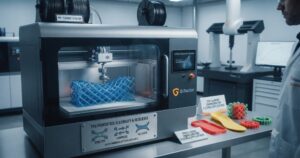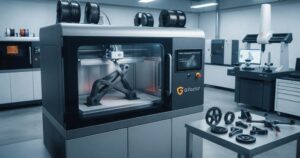
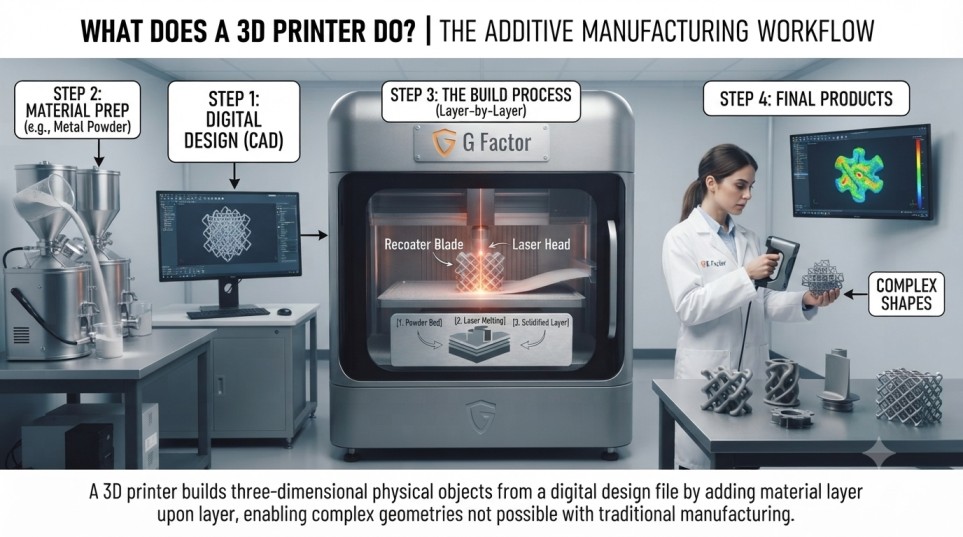
If you have ever wondered how a digital file on a computer screen transforms into a physical, real-world object you can hold in your hand, you are asking one of the fundamental questions of modern engineering. Traditional manufacturing builds objects by cutting material away from a solid block of metal or plastic. Modern digital manufacturing flips this concept on its head.
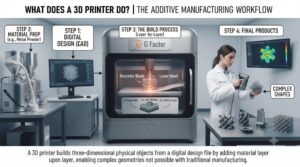
So, what does a 3D printer do? At its core, a 3D printer takes a 3D computer design file and turns it into a solid physical object by depositing, melting, or fusing material layer upon layer until the complete item is built.
Whether producing custom medical prosthetics, lightweight aerospace components, automotive prototypes, or intricate architectural models, 3D printers are transforming how industries bring ideas to life. In this ultimate guide, we will break down what a 3D printer does, explore how the technology works step-by-step, review essential materials, compare key printing methods, and examine real-world applications across major industries.
What Does a 3D Printer Do? (The Core Concept Explained)
To understand what a 3D printer does without getting tangled in technical jargon, consider two contrasting methods of creating an object:
-
Subtractive Manufacturing (Carving a Marble Statue): Traditional methods like CNC milling start with a solid block of raw material (aluminum, steel, or plastic) and use rotary drills, lathes, and blades to chip and cut away everything you do not need. This leaves behind substantial scrap material and limits the internal geometric shapes you can physically carve out.
-
Additive Manufacturing (Building a Layered Cake): A 3D printer starts with nothing. Guided by digital instructions, it applies material only where needed, building the structure vertically, layer by ultra-thin layer.
Because a 3D printer builds additively, it eliminates the need for expensive upfront tooling or custom molds. Engineers can produce complex internal lattices, hollow voids, and organic shapes that would be impossible to manufacture using traditional cutting tools.
How Does a 3D Printer Work? Step-by-Step
While different types of 3D printers use various light sources, heating elements, or mechanical gantries, every 3D printing project follows a standard 5-step digital-to-physical workflow.
-
Digital Design Creation (CAD): An engineer designs a three-dimensional representation of an object using 3D Computer-Aided Design (CAD) software like SolidWorks, Fusion 360, or Blender.
-
File Export (STL, OBJ, or 3MF): The complete design is exported as a 3D-mesh file. Modern setups favor 3MF files, which store material and structural properties alongside geometry data, while legacy workflows rely on STL files.
-
Slicing the Model: The exported file is loaded into slicing software. The slicer horizontally divides the model into hundreds or thousands of thin cross-sectional layers and translates the design into G-code—the exact motion, speed, and temperature instructions the printer follows.
-
Physical Printing: The 3D printer executes the G-code instructions. The printhead traces each layer path, extruding molten plastic, curing liquid resin, or sintering powdered particles before stepping up vertically to deposit the next layer.
-
Post-Processing: Once the build finishes and cools, the part is removed from the build plate. Post-processing steps may include removing support structures, light sanding, thermal curing, or secondary CNC machining for precision surfaces.
Key Types of 3D Printing Technologies
Not all 3D printers operate the same way. The industry categorizes 3D printing into distinct technologies based on how materials are deposited and bonded.
1. Fused Filament Fabrication (FFF) / Fused Deposition Modeling (FDM)
FFF is the most common form of plastic 3D printing. Spooled thermoplastic wire is pulled through a heated extruder, melted, and pushed through a fine nozzle onto a build platform. High-precision platforms like the G300 Pro and versatile systems like the G500pro showcase how FFF printers deliver high accuracy for detailed enclosures, brackets, and jigs.
2. Fused Granular Fabrication (FGF) / Pellet 3D Printing
Instead of feeding spooled filament wire, FGF printers use a screw-driven extrusion system that processes raw, bulk plastic granules—the exact pellets used in standard injection molding. FGF systems deliver massive output speeds (up to 15+ kg/hr) and dramatic material cost reductions. Large-scale gantries like the JS-FGF-AM-2420 allow factories to produce full-scale automotive panels, furniture, and large molds in hours rather than days.
3. Stereolithography (SLA) & Digital Light Processing (DLP)
Vat photopolymerization relies on light-curable liquid resins. A UV laser or digital projector shines light across a liquid resin pool, curing and hardening the liquid into solid plastic layer by layer. This technique produces exceptionally smooth surface finishes and fine details for dental models and jewelry.
4. Powder Bed Fusion (SLS & DMLS/SLM)
Powder bed systems use high-powered lasers to selectively melt or sinter thermal plastic or metal powders.
-
Selective Laser Sintering (SLS): Uses a laser to sinter thermoplastic powder (like Nylon PA12). The surrounding unfused powder supports the part, eliminating the need for temporary print supports.
-
Direct Metal Laser Sintering (DMLS): Fuses fine metallic powders (titanium, stainless steel, aluminum) into high-strength, end-use metal engine parts and aerospace brackets.
Comparing FFF (Filament) vs. FGF (Pellet) 3D Printers
For industrial facilities evaluating plastic extrusion systems, the choice usually comes down to FFF vs. FGF. Both build parts layer by layer, but their speed, cost, and intended applications differ significantly.
Explore real-world industrial systems across both categories in our specialized catalogs for FFF 3D Printers and heavy-duty FGF Pellet 3D Printers.
| Feature / Capability | Fused Filament Fabrication (FFF) | Fused Granular Fabrication (FGF) |
| Material Input | Processed spooled filament wire | Raw industrial plastic pellets |
| Deposition Speed | Standard (15 g/hr to 300 g/hr) | Ultra-high (1,000 g/hr to 15,000+ g/hr) |
| Material Cost | Standard spooled cost ($30 – $100+/kg) | Low bulk cost ($3 – $15/kg) |
| Detail & Feature Fine Resolution | High precision (fine features & thin walls) | Coarser layer lines (ideal for large structures) |
| Best Suited For | Precision jigs, prototypes, complex enclosures | Full-scale auto body panels, large molds, furniture |
FFF (Filament Systems)
Compact and mid-sized FFF machines like the G220 and G610 excel at producing high-resolution parts where smooth surface details, fine threads, and thin walls are required. High-temperature systems like the GPEEK300 handle advanced engineering plastics capable of replacing metal parts.
FGF (Pellet Systems)
Large-format pellet machines like the JS-FGF-1800Pro and hybrid setups like the JS-FGF-HM-3000 are built for large-scale industrial output. By printing directly with bulk granules, pellet systems reduce feedstock costs by up to 80% while enabling rapid manufacturing of large objects up to several meters in size.
What Materials Can a 3D Printer Use?
Modern 3D printers process a wide variety of materials engineered for specific mechanical, thermal, and chemical demands. To discover the right feedstock for your application, explore our master guide to 3D Printing Materials.
Prototyping & Standard Polymers
-
PLA (Polylactic Acid): Easy-to-print, bio-based material ideal for early concept models and visual prototypes.
-
ABS (Acrylonitrile Butadiene Styrene): Impact-resistant material used for durable housings, automotive interiors, and consumer goods.
-
PETG: Combines ease of printing with chemical resistance and toughness for functional enclosures and liquid containers.
Flexible Elastomers
-
TPU (Thermoplastic Polyurethane): Flexible, rubber-like material ideal for custom seals, gaskets, protective boots, and shock-absorbing mounts.
Fiber-Reinforced Engineering Composites
Adding carbon fiber or glass fiber to base polymers creates rigid structural materials. Find options across our range of FFF Filament Materials and bulk FGF Pellet Materials.
-
PC+CF (Polycarbonate + Carbon Fiber): High structural strength and heat resistance for manufacturing jigs, fixtures, and vacuum forming tooling.
-
PA+GF (Nylon + Glass Fiber): Outstanding fatigue resistance and durability under harsh chemical and thermal environments.
-
PP+GF (Polypropylene + Glass Fiber): Lightweight and chemically inert material suited for fluid handling and outdoor applications.
-
PLA-CF: Rigid carbon-fiber blend providing a matte surface finish and improved dimensional stability.
High-Temperature Ultra-Polymers
-
PPS+CF & PESU+CF: High-performance technical polymers designed for continuous service temperatures exceeding 200°C, frequently used as direct metal replacements in demanding environments.
Real-World Industrial Applications: What Do Companies Print?
3D printing has evolved from simple prototyping into a core manufacturing strategy across major global sectors. Learn how these technologies are applied across sectors in our 3D Printing Industries Overview or read more About GFac.
-
Automotive 3D Printing: Car manufacturers print assembly line jigs, customized interior components, and full-scale concept body panels. Pellet systems like the JS-FGF-800Pro help automotive teams create large components in a fraction of the time required for traditional tooling.
-
Aerospace 3D Printing: Aerospace engineers use high-performance materials to print lightweight cabin fixtures, air ducting, and composite layup tooling, reducing aircraft weight and improving fuel efficiency.
-
Architecture 3D Printing: Architectural firms print complex formwork for concrete casting, detailed scale models, and structural facades directly from digital CAD files.
-
Medical 3D Printing: Healthcare providers print custom, patient-matched orthopedic insoles, prosthetic limbs, and surgical planning guides using flexible and biocompatible materials.
-
Creative & Large Formats: Artists, designers, and event fabricators use machines like the JS-FGF-1200 and large-format systems like the GM1000 1.75mm or GM1000 3.5mm for Sculpture 3D Printing, Furniture 3D Printing, and custom Display 3D Printing.
4 Benefits of Using a 3D Printer in Production
Deploying 3D printing in a product development or manufacturing pipeline offers clear operational advantages:
-
Rapid Lead-Time Reduction: Transform a digital CAD design into a physical part in hours instead of waiting weeks for external tooling or CNC lead times.
-
Design Freedom: Produce complex geometries, internal cooling channels, and lightweight lattice structures that traditional cutting tools cannot replicate.
-
Reduced Material Waste: Additive deposition uses up to 90–95% of input material, whereas subtractive machining often generates significant material scrap.
-
Cost-Effective Low-Volume Production: Print custom, single-unit parts or small production batches without paying thousands of dollars for hard molds or setup tooling.
Frequently Asked Questions (FAQ)
What does a 3D printer do in simple terms?
A 3D printer creates physical 3D objects from digital computer files by laying down thin layers of material on top of each other until the object is complete. Have more questions? Visit our comprehensive GFac FAQ Page.
Can a 3D printer print strong, functional parts?
Yes. Modern 3D printers use engineering materials like carbon-fiber-reinforced Nylon, Polycarbonate, and high-temperature PEEK to produce strong functional parts capable of replacing metal components in demanding applications.
What is the main difference between 3D printing and standard CNC machining?
3D printing is an additive process that builds objects layer by layer, generating minimal waste. CNC machining is a subtractive process that cuts material away from a solid block, creating extra scrap shavings.
Is 3D printing expensive to run?
Operational costs depend on the material and technology used. Traditional filament printing is cost-effective for small parts, while industrial FGF pellet printers dramatically lower costs for large parts by using raw plastic granules priced up to 80% lower than filament spools.
Summary Key Takeaways
-
Additive Layering: A 3D printer converts digital CAD files into physical objects by depositing material layer by layer.
-
Technology Choice: FFF filament printers excel at fine details and compact parts, while FGF pellet printers deliver ultra-fast output and lower material costs for large-scale production.
-
Versatile Feedstock: Materials range from simple prototyping plastics (PLA, ABS) to composite engineering polymers (PC+CF, PA+GF) and high-temperature plastics.
-
Industrial ROI: 3D printers reduce lead times, lower tooling expenses, and unlock design flexibility across automotive, aerospace, medical, and architectural industries.
Explore Industrial 3D Printing Solutions
Whether you need high-resolution desktop units for detailed prototypes or heavy-duty pellet systems for large-scale industrial output, adopting the right additive technology will help streamline your production workflow.
Ready to see what a 3D printer can do for your business? Browse our catalog of GFac Products, read expert guides on our 3D Printing Blog, or Contact Our Team today to request a quote, schedule a print demo, or consult with our engineering specialists. You can also review our Privacy Policy to see how we protect your project data.