Traditional plastic 3D printing revolutionized rapid prototyping, but early materials often lacked the rigidity and thermal endurance needed for demanding structural applications. Enter carbon fiber 3D printing—a game-changing advancement that bridges the gap between lightweight thermoplastics and high-strength industrial metals.
By combining high-performance polymers with ultra-stiff carbon fibers, carbon fiber 3D printing produces parts with remarkable strength-to-weight ratios, high heat deflection temperatures, and superior dimensional stability.
In this comprehensive guide, we will explore how carbon fiber 3D printing works, compare chopped vs. continuous fibers, review key composite materials, examine industrial applications, and highlight key best practices for successful printing.
What Is Carbon Fiber 3D Printing?
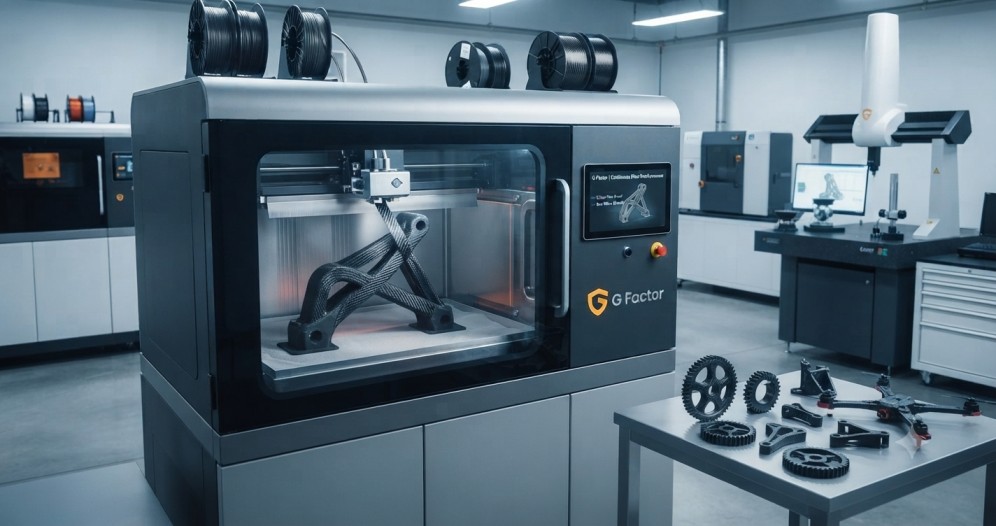
Carbon fiber 3D printing is an additive manufacturing process that incorporates carbon fiber reinforcement into a thermoplastic matrix during the build process.
Standard 3D printing plastics like PLA or ABS can flex or deform under mechanical stress. When microscopic carbon fibers are blended into the plastic matrix—or continuous carbon strands are laid down alongside the polymer—the resulting composite part exhibits significantly higher tensile strength, enhanced stiffness, and lower thermal expansion.
Chopped vs. Continuous Carbon Fiber: Key Differences
When selecting a composite printing system, it is critical to understand the two primary forms of carbon fiber reinforcement:
| Feature | Chopped Carbon Fiber Composite | Continuous Carbon Fiber Reinforcement |
| Fiber Structure | Microscopic fiber strands (typically 0.1–0.4 mm) mixed evenly into plastic pellets or filament spools. | Long, unbroken strands of carbon fiber laid down alongside the plastic matrix during printing. |
| Strength & Stiffness | 1.5× to 3× stiffer than neat plastics; isotropic strength in X/Y axes. | Comparable to or exceeding aluminum in directional tensile strength; highly anisotropic. |
| Hardware Compatibility | Compatible with standard FFF and FGF systems fitted with hardened nozzles. | Requires specialized dual-extrusion hardware equipped with continuous fiber cutting mechanisms. |
| Best Suited For | Complex functional parts, jigs, fixtures, enclosures, and high-volume pellet production. | Heavy-load structural beams, flight components, and critical metal replacement parts. |
Popular Carbon Fiber 3D Printing Materials
The mechanical performance of a carbon fiber composite depends heavily on the base polymer (matrix) carrying the fibers. Explore available chemistries in our detailed guide to 3D Printing Materials.
1. Carbon Fiber Polycarbonate (PC+CF)
Polycarbonate provides high intrinsic toughness and heat resistance. When blended with carbon fiber, PC+CF exhibits high tensile strength and minimal thermal warping, making it ideal for vacuum forming tools, automotive housings, and heavy-duty jigs.
2. Carbon Fiber Nylon (PA+CF)
Nylon is prized for its high fatigue endurance and chemical resistance. Adding carbon fiber counters Nylon’s tendency to absorb moisture and warp during printing, yielding strong, impact-resistant industrial components.
3. High-Temperature Composites (PPS+CF & PESU+CF)
For extreme thermal and chemical environments, high-temperature technical polymers reinforced with carbon fiber—such as PPS+CF and PESU+CF—can survive continuous operating temperatures exceeding 200°C. These materials are widely used as metal replacements in aerospace ducting, under-the-hood automotive components, and composite autoclave tooling.
4. Carbon Fiber PLA (PLA-CF)
For accessible stiffness without demanding thermal requirements, PLA-CF delivers enhanced rigidity over standard PLA along with a clean, matte surface finish that hides visible layer lines—ideal for drone frames, lightweight brackets, and visual prototypes.
To evaluate composite options for both spooled and bulk production setups, review our dedicated catalogs for FFF Filament Materials and FGF Pellet Materials.
FFF vs. FGF for Carbon Fiber Printing
Both spooled filament systems and bulk pellet extruders handle carbon fiber composites, but they serve different production scales:
-
Fused Filament Fabrication (FFF): Spooled composite filaments excel at fine details, thin walls, and high-precision mechanical assemblies. Browse high-performance composite machines in our catalog of FFF 3D Printers, including compact platforms like the G300 Pro and ultra-polymer systems like the GPEEK300.
-
Fused Granular Fabrication (FGF / Pellet Extrusion): For large molds, vehicle panels, and structural tooling, buying carbon fiber materials in bulk pellet form cuts feedstock costs by 60% to 80% while enabling deposition rates up to 15+ kg/hr. Explore pellet platforms in our list of FGF Pellet 3D Printers, such as the JS-FGF-800Pro and heavy-duty gantry units like the JS-FGF-AM-2420.
Industrial Applications of Carbon Fiber 3D Printing
Across modern manufacturing, carbon fiber composite printing actively replaces traditional machined aluminum and steel parts. Learn more about market implementations on our 3D Printing Industries Overview.
-
Automotive & Racing: Lightweight brackets, intake manifolds, custom interior subframes, and quick-turn production fixtures. See dedicated solutions under Automotive 3D Printing.
-
Aerospace & Defense: Weight-optimized drone arms, internal cabin ducting, satellite mounting plates, and high-temp autoclave tooling for carbon fiber layup cycles. Read more under Aerospace 3D Printing.
-
Manufacturing Tooling & Jigs: End-of-arm robotic tooling (EOAT), assembly alignment jigs, and soft jaws for CNC workholding.
-
Prosthetics & Medical Devices: Custom lightweight leg braces, functional hand prosthetics, and patient-matched orthotic supports. Learn more under Medical 3D Printing.
4 Best Practices for Carbon Fiber 3D Printing
Because carbon fiber is abrasive and mechanically unique, running composite materials successfully requires proper machine configuration:
-
Use Hardened Nozzles: Carbon fibers act like microscopic sandpaper inside brass nozzles, quickly widening the orifice and ruining print accuracy. Always use hardened steel, ruby-tipped, or tungsten carbide nozzles when printing composite materials.
-
Dry Your Feedstock Thoroughly: Engineering base polymers like PA, PC, and PESU are highly hygroscopic (they readily absorb ambient moisture). Wet material leads to steam bubbling, weak layer adhesion, and poor surface finish.
-
Optimize Nozzle Diameter: Because chopped fibers can catch on tiny orifice restrictions, use nozzle diameters of 0.4 mm or larger for filament printing, and 2.0 mm or larger for pellet extrusion to ensure smooth material flow.
-
Maintain High Enclosure Temperatures: Carbon fiber reduces thermal expansion, but high-temperature base polymers still require enclosed build chambers and heated beds to prevent layer delamination during long build cycles.
Frequently Asked Questions (FAQ)
Is carbon fiber 3D printing stronger than metal?
While chopped carbon fiber plastics generally do not match the absolute ultimate strength of solid steel or structural aluminum, continuous carbon fiber prints can match or exceed aluminum in strength-to-weight ratio while remaining up to 50% lighter. Have more general questions? Visit our GFac FAQ Page.
Does carbon fiber ruin standard 3D printer nozzles?
Yes. Carbon fibers are extremely abrasive and will wear down standard brass nozzles within a few hundred grams of printing. Hardened steel or specialized wear-resistant nozzles are mandatory.
Why is carbon fiber 3D printing popular for tooling and jigs?
Carbon fiber composites reduce tool weight (making robotic arms faster and manual tools easier for workers to handle), eliminate long CNC machining lead times, and resist chemical solvents and thermal warping on the factory floor.
Key Takeaways
-
Lightweight Strength: Carbon fiber 3D printing blends polymer matrices with carbon fibers to create high-strength, low-weight structural parts.
-
Form Factor Options: Chopped fiber composites work across standard FFF and high-throughput FGF pellet systems, while continuous fiber systems offer maximum directional tensile strength.
-
Abrasive Hardware Needs: Printing carbon fiber requires hardened nozzles, dried feedstock, and proper thermal management.
Explore Advanced Composite 3D Printing Solutions
Whether you need lightweight fixtures, end-of-arm tooling, or heavy-duty composite molds, selecting the right material and hardware is key to unlocking the full power of additive manufacturing.
To learn more about industrial composite printing systems, browse all GFac Products, learn about our company heritage About GFac, read technical insights on our 3D Printing Blog, or Contact Our Engineering Team today for custom quotes and project evaluations. You can also review our Privacy Policy to see how we manage your project data.