Introduction: Manufacturing Is Entering a Structural Turning Point
In modern industrial environments, something fundamental is changing.
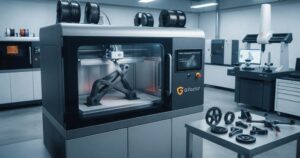
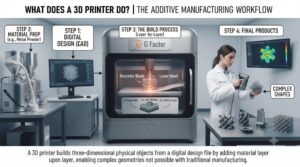
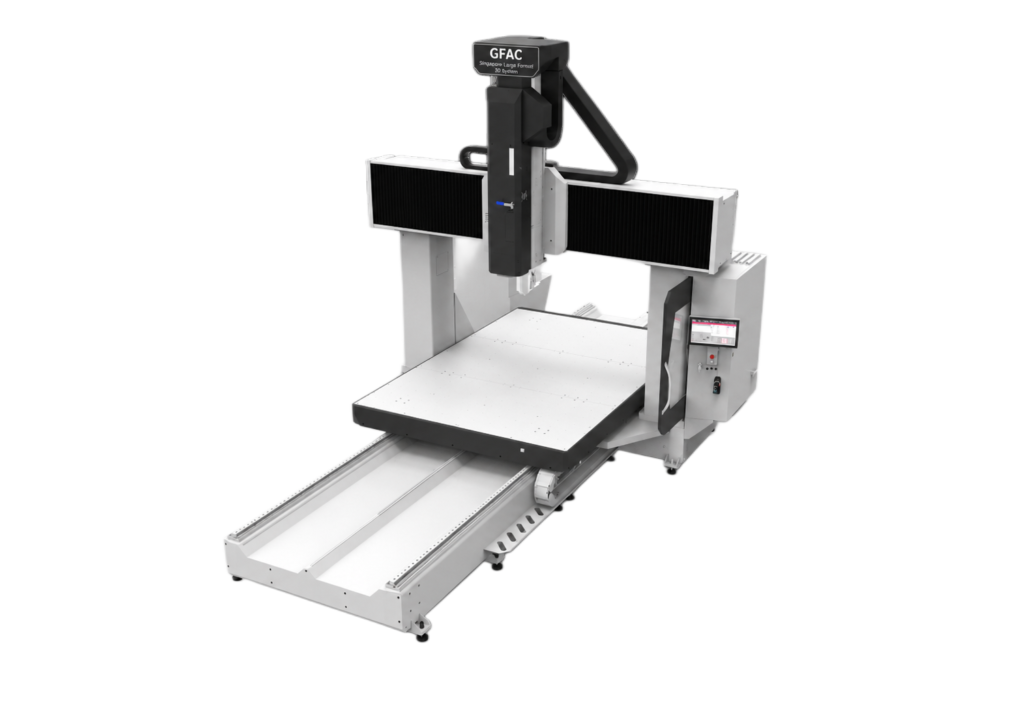
Factories that once depended on molds, tooling, machining, and multi-part assembly are now shifting toward direct digital manufacturing at scale. At the center of this transformation is the large format 3D printer, a system capable of producing full-scale functional parts in a single continuous build.
Imagine a production floor where an automotive bumper, a structural machine housing, or a construction mold is created without segmentation, joints, or adhesives. Instead of assembling parts, engineers now manufacture entire structures as unified components.
This is not a future concept. It is already happening across automotive, aerospace, architecture, and heavy manufacturing industries.
Companies adopting industrial systems like GFac industrial manufacturing systems are reducing production cycles, eliminating tooling delays, and reshaping how physical products are designed.
Why Traditional Manufacturing Struggles at Scale
Before large-format additive systems became viable, manufacturing large parts required a fragmented workflow.
Engineers had to:
- Break CAD models into smaller printable sections
- Manufacture parts separately
- Align and glue components manually
- Reinforce weak bonding seams
- Perform extensive post-processing
This approach introduced multiple failure points.
The Real Engineering Problems
1. Structural Weakness at Joints
Every glued or welded seam becomes a stress concentration point. Under vibration, heat, or torque, these joints often fail first.
2. Labor-Heavy Assembly Process
Highly skilled technicians are required to align, bond, and finish each segment, significantly increasing production cost.
3. Dimensional Drift
When parts are printed at different times, environmental variation leads to inconsistencies in shrinkage and alignment.
4. Production Inefficiency
Instead of one continuous process, manufacturing becomes a multi-stage assembly pipeline.
These limitations made desktop-scale additive manufacturing unsuitable for real industrial deployment.
The Industrial Breakthrough: True Large Format Manufacturing
Large format additive systems eliminate fragmentation entirely.
Modern machines can produce parts with build volumes reaching:
3500 × 2400 × 1000 mm
This shift enables true unibody manufacturing, where an entire part is created in one continuous operation.
Instead of assembling components, engineers now design for:
- Structural continuity
- Material uniformity
- Integrated geometry
This change alone removes one of the biggest inefficiencies in industrial production.
Two Core Technologies Powering Industrial Scale Printing
Industrial large-format systems are built on two dominant technologies:
1. FFF Technology – Precision Engineering at Large Scale
FFF (Fused Filament Fabrication) is the most widely used method for precision industrial additive manufacturing.
You can explore systems here:
👉 FFF 3D printing systems
And materials here:
👉 FFF filament materials guide
How FFF Works in Industrial Systems
FFF uses engineered thermoplastic filament, melted and deposited layer by layer through a controlled extrusion system.
Industrial systems differ from desktop printers in several ways:
- Closed-loop servo motor control
- Multi-zone heated chambers
- High-temperature extrusion systems (up to 320°C+)
- Reinforced mechanical frames
Where FFF Excels
FFF is ideal when:
- Precision is more important than speed
- Surface quality matters
- Complex internal geometries are required
Common Applications
- Aerospace brackets
- Functional prototypes
- Mechanical housings
- Engineering fixtures
2. FGF Technology – High-Volume Pellet-Based Manufacturing
FGF (Fused Granular Fabrication) represents the high-throughput side of industrial additive manufacturing.
Explore systems here:
👉 FGF pellet extrusion systems
Material systems:
👉 FGF pellet materials guide
How FGF Works
Instead of filament, FGF systems use raw plastic pellets.
A screw-based extrusion system melts and deposits material at extremely high flow rates.
Why FGF Is a Game-Changer
- Extremely high deposition speed
- Low raw material cost
- Ability to produce massive parts quickly
FGF systems can deposit kilograms of material per hour, making them ideal for industrial-scale production.
FFF vs FGF: Engineering Comparison Table
| Feature | FFF Systems | FGF Systems |
|---|---|---|
| Material Type | Filament | Plastic pellets |
| Precision Level | Very high | Medium-high |
| Production Speed | Moderate | Very fast |
| Material Cost | Higher | Up to 80% lower |
| Best Use Case | Precision engineering | Large structural parts |
| Typical Industries | Aerospace, prototyping | Automotive, tooling, construction |
The Economic Impact: Why Industry Is Switching to FGF
The biggest advantage of FGF is not technical—it is economic.
Material Cost Breakdown
- FFF filament: $25–$60/kg
- FGF pellets: $3–$12/kg
This creates up to 80% cost savings in raw materials alone.
For large-scale production, this difference is massive.
A single industrial project involving hundreds of kilograms of material can save thousands of dollars.
Eliminating Tooling: The Biggest Manufacturing Disruption
Traditional manufacturing depends on tooling:
- CNC-machined molds
- Steel dies
- Casting molds
- Injection tooling systems
These require:
- Weeks of setup time
- High upfront investment
- High risk of redesign cost
Large format additive systems eliminate tooling entirely.
With systems like GFac industrial platform, manufacturers can:
- Design CAD model
- Print directly
- Test immediately
- Iterate rapidly
This reduces product development cycles from months to days.
Industrial Ecosystem and Material Integration
Modern production requires a full ecosystem of machines and materials.
Explore the ecosystem here:
👉 GFac industrial systems overview
Material ecosystem:
Real-World Industrial Applications
Automotive Industry
Large format systems are widely used for:
- Full bumper prototypes
- Structural body panels
- Assembly jigs and fixtures
The key advantage is eliminating segmented assembly workflows.
Aerospace Engineering
Applications include:
- Lightweight brackets
- Air duct systems
- Composite tooling molds
Here, weight reduction and strength optimization are critical.
Architecture and Construction
Large format systems enable:
- Concrete casting molds
- Complex façade elements
- Structural installation prototypes
Architects can now fabricate geometry that was previously impossible.
Advanced Materials in Industrial 3D Printing
Material selection determines performance more than the printer itself.
Engineering Polymers
- ABS
- PLA
- PETG
Reinforced Composites
- Carbon fiber reinforced polymers (PC-CF)
- Glass fiber reinforced nylon (PA-GF)
- Polypropylene composites (PP-GF)
High-Performance Materials
- PPS-CF
- PESU composites
- TPU elastomers
Each material is selected based on:
- Heat resistance
- Mechanical load
- Chemical exposure
- Flexibility requirements
Step-by-Step Industrial Workflow
Step 1: CAD Design Optimization
Design must account for thermal stress distribution.
Step 2: Material Conditioning
Moisture removal is essential for structural quality.
Step 3: Slicing Strategy
Advanced infill patterns like gyroid improve strength-to-weight ratio.
Step 4: Thermal Control
Stable chamber temperature ensures layer bonding integrity.
Frequently Asked Questions (AEO Optimized)
What is a large format 3D printer?
A large format 3D printer is an industrial machine capable of producing parts larger than 500 × 500 × 500 mm in a single build.
What is the difference between FFF and FGF?
FFF uses filament for precision manufacturing, while FGF uses pellets for high-speed, low-cost production.
Can large format 3D printing replace injection molding?
In many low and medium volume applications, yes, especially for prototypes and tooling.
Which industries benefit most?
Automotive, aerospace, architecture, marine engineering, and industrial tooling.