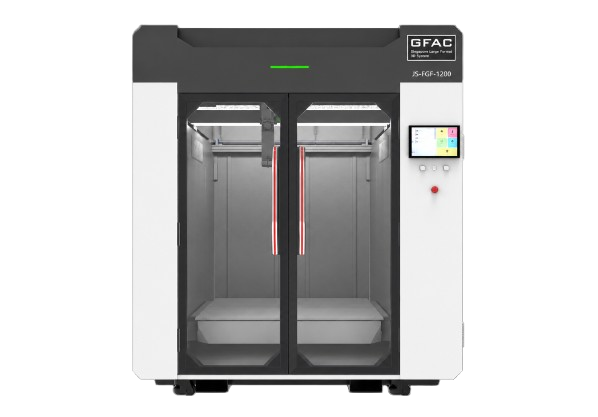
Traditional manufacturing methods place heavy restrictions on product development lifecycles. Creating functional prototypes, engineering assemblies, or custom assembly fixtures via CNC machining or injection molding requires massive upfront tooling costs, complex programming, and weeks of factory lead time. If an initial design revision fails a mechanical stress analysis, the physical molds must be scraped and completely remade, compounding overhead expenses and delaying time-to-market.
Furthermore, standard commercial work environments require robust components that handle continuous physical fatigue, high heat exposure, and chemical contact. Desktop-level 3D printers fail under these demands—they lack the structural rigidity, thermal stability, and closed-loop precision necessary to process advanced engineering thermoplastics without warping or delaminating.
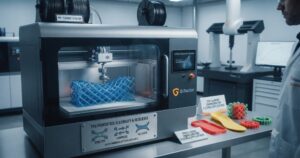
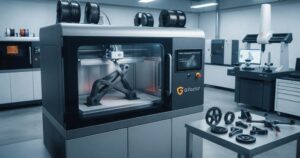
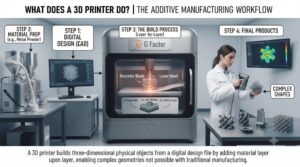
Implementing an industrial FDM 3D printer (Fused Deposition Modeling) completely removes these manufacturing bottlenecks. FDM—technically known across open-source industrial frameworks as Fused Filament Fabrication (FFF)—is an automated additive manufacturing process that melts and extrudes engineering-grade thermoplastic filaments layer-by-layer with extreme dimensional accuracy. By executing toolpaths directly from digital CAD models, industrial FDM setups bypass legacy tooling restrictions, dropping custom component lead times from weeks down to less than 24 hours while optimizing total material yield.
At G Factor, we engineer heavy-duty, production-grade additive hardware platforms optimized for demanding industrial environments. From our compact, high-precision FFF series systems built for daily engineering iteration to monumental pellet-fed setups, our machinery equips engineering firms, automotive suppliers, and aerospace fabricators across Singapore and international markets to manufacture functional parts with total repeatability.
1. Mechanical Architecture: Inside an Industrial FDM Platform
To deliver continuous structural repeatability across long, multi-day print cycles, an industrial FDM 3D printer relies on robust structural engineering and advanced thermal management systems rather than basic desktop components.
Closed-Loop Servo Control Systems
Standard desktop printers utilize open-loop stepper motors that cannot detect position errors. If a nozzle strikes a slightly warped plastic edge during high-speed travel, the axis slips, ruining the entire print through layer shifting. Industrial FDM platforms eliminate this vulnerability by integrating high-torque, closed-loop servo motor control networks. These systems continuously monitor physical encoder positions in real time, making instant micro-step corrections to maintain tight dimensional tolerances under aggressive acceleration profiles.
Thermal Zone Stabilization
High-performance engineering polymers shrink and warp if exposed to sudden thermal fluctuations during cooling. Industrial machines feature structural heated print beds and fully enclosed, thermally isolated build chambers. By maintaining an elevated, uniform ambient environment around the part during printing, the system neutralizes internal residual stresses, ensuring flawless interlayer adhesion and eliminating split lines or base warping.
Dual High-Temperature Extrusion Configurations
Processing advanced composite filaments demands rugged, direct-drive extrusion paths. Industrial-grade hotends utilize hardened steel or titanium nozzles capable of sustaining continuous operating temperatures up to 320°C or higher. Dual-extrusion layouts enable the printer to deposit complex structural polymers from the primary nozzle while simultaneously using a secondary nozzle to build intricate geometric supports out of soluble or breakaway materials. This allows engineers to print complex internal cavities and deep undercuts without risking surface marring during final post-processing.
2. Material Dynamics: From Concept Prototyping to Functional End-Use
The operational flexibility of an FDM system is rooted directly in the diverse range of verified material arrays it can process. By adjusting filament characteristics, operators can tailor parts to precise mechanical, thermal, or chemical environments.
Standard and Toughened Polymers
-
PLA (Polylactic Acid): The absolute workhorse for early-stage conceptual validation and aesthetic models. PLA prints quickly with minimal thermal shrinkage, making it ideal for rapid form-and-fit testing.
-
PETG (Polyethylene Terephthalate Glycol): Combining the processing ease of PLA with enhanced impact strength and chemical resistance, PETG serves as the go-to choice for functional mechanical housings, water-resistant containers, and low-wear snap-fit assemblies.
Engineering-Grade Synthetics
-
ABS (Acrylonitrile Butadiene Styrene): A highly durable polymer offering excellent impact absorption and higher heat deflection limits. ABS is heavily deployed within automotive prototyping and consumer electronics product lines.
-
ASA (Acrylonitrile Styrene Acrylate): Retaining the high mechanical strength of ABS while introducing exceptional UV and moisture resistance. ASA is the premier choice for outdoor industrial enclosures, marine components, and exterior architectural fixtures.
Carbon Fiber Reinforced Composites
-
PLA-CF and Nylon-CF Alloys: By embedding short-strand carbon fibers directly into the polymer matrix, these advanced materials drastically increase component stiffness, tensile strength, and dimensional stability. Carbon-fiber composites substitute effectively for aluminum brackets, custom machining jigs, and heavy-duty assembly tooling fixtures, significantly reducing structural weight.
3. High-Fidelity Solutions: The G300 Pro Industrial System
For engineering groups and R&D laboratories looking to transition from basic desktop printing to high-reliability production, the G Factor G300 Pro Industrial 3D Printer offers a professional, space-efficient solution.
The G300 Pro provides an expansive $300 \times 300 \times 400\text{ mm}$ build envelope in a rigid, vibration-dampened frame designed for daily, unmonitored production. Key industrial configurations integrated natively into the system include:
-
Integrated Auto-Leveling: Eliminates manual leveling errors by mapping a high-density bed mesh before every print run, ensuring perfect first-layer adhesion.
-
Filament Flow Auditing: Smart runout sensors halt the print toolpath immediately if a spool finishes or jams, preserving the print state and preventing mid-stage failures.
-
Power Restoration Processing: If an unexpected facility power outage occurs, the machine logs the exact coordinate state, allowing operators to safely resume production the moment power returns.
4. Comparing Tooling Workflows: Machining vs. Additive FDM
To evaluate the clear financial and operational advantages of integrating industrial FDM printers, consider how additive printing compares against traditional subtractive machining processes.
Production Lead Time
Traditional CNC machining requires extensive stock setup, part programming, and fixture installation, typically requiring 3 to 10 business days for a custom tool or jig. An industrial FDM system processes the file through slicing software within minutes, delivering ready-to-use parts within 24 hours.
Material Waste Optimization
Substractive CNC milling starts with a solid metal or plastic block, machining away up to 80 percent of the raw material as scrap shavings. FDM additive manufacturing deposits plastic strictly where needed along defined toolpaths, reducing component production waste to under 2 percent.
Geometric Configuration Capacity
CNC milling cutters cannot easily navigate sharp internal corners, deep blind pockets, or complex internal fluid channels without dividing the assembly into multiple pieces. FDM printing builds internal honeycomb infills and hollow chambers effortlessly, allowing for massive part consolidation and structural optimization.
Tooling Procurement Costs
Outsourcing low-volume custom manufacturing or specialized shop fixtures carries high minimum order charges and premium programming rates. Bringing FDM production in-house slashes per-part fabrication expenses by up to 85 percent, quickly delivering a full return on machinery investment.
5. Industrial Applications Across Modern Tech Sectors
Automotive Component Prototyping
Automotive suppliers utilize large-format FDM setups to print full-scale intake manifolds, interior dashboard trim, and custom ducting components. Testing prototypes in production-grade materials like ASA allows engineering teams to perform real-world aerodynamic, thermal, and mechanical fit checks before opening expensive production molds.
Assembly Line Jigs and Fixtures
Factory floors require specialized holding nests, alignment templates, and robotic end-of-arm tooling. Machining these items out of aluminum is time-consuming and risks scratching delicate consumer parts. Printing custom jigs with carbon-fiber reinforced nylon creates lightweight, incredibly strong tooling that protects components and improves assembly ergonomics.
Architectural Visualizations
Design firms and structural engineers print high-detail architectural models directly from structural layouts. Utilizing stable polymers allows teams to present highly accurate spatial models to developers, zoning boards, and investment partners, bypassing manual modeling delays.
6. Optimization Protocol: Maximizing FDM Structural Performance
The mechanical durability of an FDM-printed part is highly dependent on software slicing configuration choices. To ensure components withstand industrial workloads, engineering teams use specific toolpath settings:
-
Infill Density Adjustments: While visual models require a light 10 to 15 percent infill, high-stress mechanical components are sliced with 40 to 80 percent infill using structural patterns like Gyroid or Cubic to distribute shear loads in all directions.
-
Shell Wall Thickness Allocation: Increasing perimeter shell wall count from 2 layers up to 4 or 6 layers significantly upgrades tensile strength and torsional rigidity, allowing parts to hold threads or accept metal press-fit inserts securely.
-
Layer Height Customization: Choosing a finer layer height (e.g., 0.12mm) improves curved surfaces and spatial tolerances, while selecting a wider layer profile (e.g., 0.30mm) drops production time by more than half for large structural pieces.
7. Answers to Critical Additive Engineering Inquiries
Is FDM technology the exact same as FFF?
Yes. FDM (Fused Deposition Modeling) and FFF (Fused Filament Fabrication) describe the exact same underlying technology: melting and extruding thermoplastic filament layer by layer. The term FDM is a registered trademark of Stratasys, while FFF was established as an open-source alternative.
How do I address moisture issues in engineering filaments?
Advanced materials like Nylon, ABS, and PC are highly hygroscopic, meaning they absorb humidity from the surrounding air. To prevent bubbling, brittleness, and weak interlayer bonds, filaments must be stored in dedicated dry cabinets and dried in specialized ovens before use.
When should a facility upgrade from filament FDM to pellet FGF?
Filament-fed FDM is optimal for high-precision components, fine surface detailing, and smaller manufacturing runs. If your production requirements shift to massive architectural cladding, oversized molds, or objects spanning multiple meters, switching to pellet-fed FGF systems drops material costs by up to 80 percent and increases volumetric deposition rates significantly.
8. Summary: Key Advantages of FDM Integration
-
Significant Cost Reductions: Lowers small-batch component and prototyping costs by up to 85 percent compared to outsourcing CNC machining.
-
Rapid Development Cycles: Compresses engineering feedback loops by fabricating functional, end-use parts within hours.
-
Diverse Engineering Materials: Supports a broad material palette from simple PLA prototypes to ultra-stiff Carbon-Fiber Nylon composites and weather-resistant ASA.
-
Near-Zero Material Waste: Additive layer path precision optimizes raw material consumption, minimizing scrap and lowering processing footprints.
9. Modernize Your Production Capabilities
Continuing to rely solely on outsourced subtractive machining for low-volume components, functional prototypes, and factory line fixtures creates unnecessary lead times and increases operating overhead. Implementing advanced FDM manufacturing solutions into your development ecosystem allows you to reduce time-to-market, eliminate tooling backlogs, and achieve absolute prototyping autonomy.
Secure an On-Site Application Review
G Factor delivers the industrial hardware platforms, advanced material selections, and expert engineering consultation required to execute high-stakes additive production. Explore our comprehensive industrial FDM options on our official homepage, or connect with our specialized technical department to arrange an on-site material compatibility review.