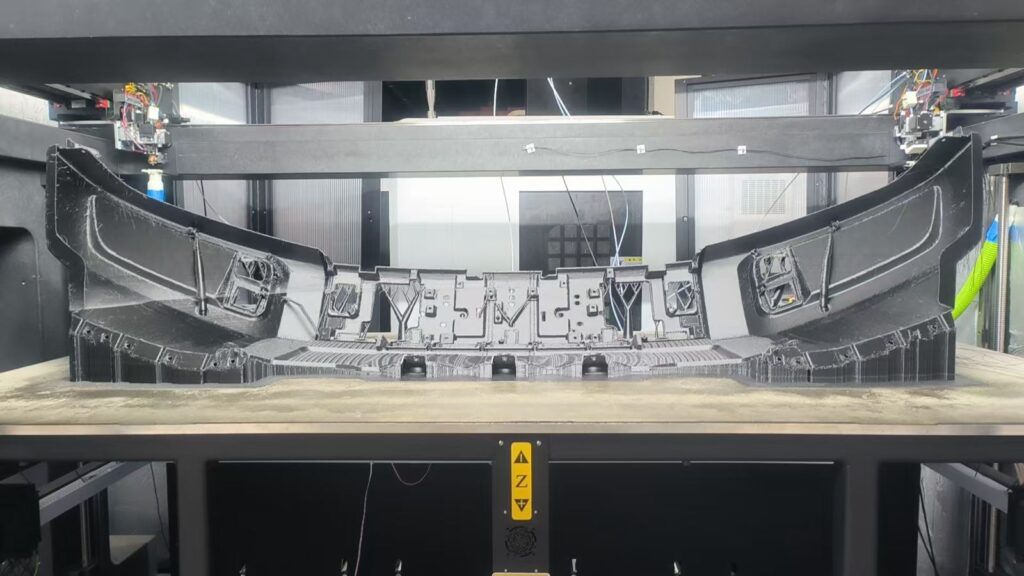
The automotive landscape is undergoing its most radical transformation since Henry Ford rolled out the moving assembly line. Driven by a massive push toward Electric Vehicles (EVs), strict weight-reduction mandates, and the absolute necessity for resilient supply chains, global carmakers are moving far beyond using 3D printing for simple plastic prototypes. Today, automotive 3D printing is a fully integrated production powerhouse. It drives everything from functional end-use parts and heavy-duty shop-floor jigs to highly complex composite tooling.
Industrial manufacturing reports show that the global automotive 3D printing market is expanding at a breakneck pace, fast approaching a multi-billion dollar valuation. This acceleration isn’t just about high-tech novelty; it is about survival on the factory floor. The vast majority of new industrial additive equipment installations are now dedicated to printing lightweight vehicle components and rapid tools that keep assembly lines moving.
At G Factor, we engineer the heavy-duty hardware, advanced firmware, and robust material workflows that allow automotive manufacturers, tier-1 suppliers, and specialized motorsport teams to deploy high-throughput production lines. From initial design tweaks to massive factory alignment fixtures, our advanced automotive 3D printer systems wipe out months of lead time and slash development costs, keeping your operations agile, responsive, and entirely localized.
1. What is Driving Additive Manufacturing in Automotive Engineering?
Traditional automotive manufacturing is notoriously rigid. It relies on capital-heavy processes like injection molding, metal stamping, and multi-axis CNC machining. While these methods are incredibly efficient for churning out millions of identical parts, they introduce massive financial and logistical headaches during initial product development, low-volume niche production runs, or custom vehicle modifications.
By stripping away the traditional constraints of Design for Manufacturing (DFM), industrial additive systems give automotive operations a distinct competitive edge through three core value drivers:
Part Consolidation and Complex Geometries
Traditional vehicle assemblies usually require fastening or welding dozens of distinct, stamped metal components together. This approach introduces multiple points of potential mechanical failure, drives up manual labor costs, and adds unnecessary weight from fasteners and adhesives.
Additive manufacturing turns this old approach on its head. It enables engineers to consolidate complex multi-part assemblies into a single, seamlessly printed component. Internal fluid channels, variable-wall HVAC ducting, and intricate structural brackets can be fabricated as a single monolithic structure. This completely eliminates fasteners, welds, and gaskets while optimizing fluid flow and structural integrity.
Radical Weight Reduction (Lightweighting)
In both internal combustion engine (ICE) vehicles and modern EV architectures, every single gram saved directly extends your vehicle’s range or fuel efficiency. By deploying advanced generative design software and topology optimization, engineers use 3D printing to deposit material only where structural stress vectors require it.
Solid metal brackets are rapidly becoming obsolete. They are being replaced by high-strength, carbon-fiber-reinforced polymers featuring optimized internal hollow cavities and engineered infill matrices. These designs maintain strict structural safety limits while cutting part mass by up to 60 percent.
Supply Chain Isolation and On-Demand Spare Parts
Maintaining massive, temperature-controlled warehouses packed with physical legacy tooling, stamping dies, and spare parts for older vehicle models is a massive drain on capital.
Digital manufacturing allows tier-1 suppliers and manufacturers to transition to a digital twin inventory system. When a legacy spare part, specialized interior trim piece, or factory-floor tool is required, the digital file goes straight to an on-site industrial printer. The component is fabricated on-demand, wiping out warehousing overheads, international customs delays, and costly assembly-line downtime.
2. Choosing Your Technology: FFF vs. FGF for Automotive Systems
Selecting the right additive manufacturing methodology depends on your required part volumes, structural mechanical properties, and economic scalability. G Factor provides dual-tier polymer technologies engineered specifically to address these varying automotive demands, scaling seamlessly from ultra-precise small components up to massive, multi-meter vehicle structures.
High-Precision FFF (Fused Filament Fabrication)
The industrial FFF series utilizes high-accuracy, spool-fed thermoplastic filaments. It remains the premier choice for automotive applications that require strict dimensional tolerances, crisp details, smooth surface finishes, and complex internal channels.
When paired with advanced FFF filament materials—such as Carbon Fiber Reinforced Nylon (PA-CF), Polycarbonate (PC), and High-Impact ABS—FFF systems excel at producing:
-
Engine Bay Components: Fluid reservoirs, sensor brackets, and intake manifolds capable of resisting continuous under-hood thermal fluctuations.
-
Cabin Architecture: Custom dashboard enclosures, ventilation bezels, instrument housings, and specialized ergonomic switchgear.
-
Electronic Integration: High-insulation brackets, sensor mounts, and protective housings for advanced driver-assistance systems (ADAS) and EV battery management modules.
High-Throughput FGF (Fused Granular Fabrication)
For large-scale automotive structures, heavy assembly shop floor fixtures, and full-scale bumper molds, traditional filament printing can become speed- and cost-prohibitive. Our industrial FGF technology bypasses the filament extrusion step entirely by feeding raw plastic pellets directly into a high-capacity, proprietary screw-driven extruder.
By directly leveraging high-grade FGF pellet materials, manufacturers realize massive engineering and economic advantages:
-
Exponential Print Speeds: Volumetric deposition rates up to 10 times faster than standard filament systems allow meters-wide automotive parts to be printed in hours instead of days.
-
Unrivaled Material Economy: Raw pelletized plastics are up to 80 percent less costly than processed filaments, making large-scale production and mold-making economically viable.
-
Structural Integrity: Excellent layer bonding and isotropic mechanical behavior, crucial for heavy-duty factory lifting jigs, bumper molds, and large aerodynamic body panels. Our FGF systems feature build volumes up to $3000 \times 2000 \times 1000\text{ mm}$ and nozzle temperatures reaching up to 450°C to handle the most demanding engineering plastics.
3. Real-World Applications Across the Automotive Value Chain
Industrial 3D printing acts as a versatile force multiplier across every phase of a vehicle’s life cycle, bridging the gap between initial styling concepts and the actual physical assembly line.
Prototype Validation & Aerodynamic Testing
Before committing millions of dollars to hard-tooling, steel stamping dies, and final production molds, automotive design teams utilize industrial 3D printing to create scale and full-size functional prototypes. High-temperature plastics allow for realistic hot-gas testing within intake manifolds, while ultra-smooth surface finishes enable highly accurate wind-tunnel evaluation of rear spoilers, diffusers, and side-mirror housings.
Production-Line Tooling, Jigs, and Fixtures
The hidden secret of modern automotive assembly plants is that 3D printers often pay for themselves entirely through factory floor optimization before a single end-use car part is even printed. Traditional aluminum or steel alignment jigs are heavy, expensive, and require weeks to machine, modify, and deploy.
Modern assembly lines utilize custom-tailored, lightweight 3D-printed carbon fiber nylon fixtures instead. These tools are ergonomically optimized for assembly workers, prevent accidental scratches on painted body panels, and can be instantly redesigned and re-printed overnight if a vehicle trim specification changes.
Customization and Limited-Run Motorsports
In hypercar production and competitive motorsports, production volumes are tiny but performance requirements are stratospheric. Additive manufacturing allows racing teams to rapidly iterate suspension brackets, brake cooling ducts, and aerodynamic winglets customized for specific track layouts or individual driver ergonomic preferences—all without the financial penalty or delays associated with minimum order quantities.
4. Comparing Tooling Methodologies: CNC Machining vs. 3D Printing
| Performance Metric | Traditional Subtractive CNC Machining | G Factor Industrial Additive Manufacturing |
| Average Tooling Lead Time | 2 to 6 Weeks (Subject to machine queues) | 24 to 48 Hours (Direct digital file to print) |
| Material Utilization Rate | Low (Up to 80% raw billet material block wasted as chips) | High (Near-zero waste; material deposited only where required) |
| Geometric Freedom | Limited by tool bit access, undercuts, and axis paths | Virtually Unlimited (Complex internal channels, lattices, overhangs) |
| Ergonomic Adaptation | Poor (Heavy metal tools fatigue operators quickly) | Excellent (Lightweight structural infills drastically reduce worker fatigue) |
| Design Revision Cost | High (Requires scrapping current tooling and re-machining) | Negligible (Simple software updates and rapid re-printing) |
5. Industrial Polymers Reshaping the Supply Chain
The ultimate field durability of an automotive component is fundamentally determined by the engineering polymer running through the machine. Car components must endure incredibly unforgiving environments: freezing winter temperatures, extreme under-hood engine heat, intensive UV exposure, and continuous exposure to corrosive oils, hydraulic fluids, and chemical cleaners.
Modern manufacturing relies on an expansive, verified material ecosystem to handle these harsh environments safely:
-
Carbon-Fiber-Reinforced Nylon (PA-CF): Possesses incredible tensile strength, stiffness, and high heat deflection temperatures, making it a reliable substitute for aluminum brackets and structural housing frames.
-
Polycarbonate (PC): Offers supreme impact resistance and structural clarity, ideal for heavy-duty protective covers, light pipes, and impact-resistant guards on the shop floor.
-
High-Performance ASA (Acrylonitrile Styrene Acrylate): Exhibiting absolute resistance to UV radiation and weathering, ASA is the go-to material for exterior functional trim components, side mirrors, and marine-adjacent automotive applications.
6. Frequently Asked Questions (FAQ)
Can 3D-printed polymer parts withstand the high temperatures inside an engine bay?
Yes, when utilizing high-performance engineering polymers. Materials like Carbon-Fiber-Reinforced Nylon (PA-CF) can achieve heat deflection temperatures (HDT) well over 150°C under load, allowing them to perform reliably in close proximity to internal combustion elements and modern electrical powertrains.
How do pellet-fed FGF systems reduce production costs compared to traditional filament printing?
FGF systems use raw plastic granules—the exact same raw material used in mass-scale injection molding. By bypassing the secondary manufacturing step required to draw pellets into precision thin filaments, material procurement costs drop by 60 to 80 percent, while extrusion rates scale exponentially.
What structural standards do your machines meet for factory integration?
Our industrial manufacturing systems are built to rigid mechanical tolerances to ensure consistency. G Factor, founded in 2025, specializes in large-format FFF and FGF systems engineered for stable, high-speed production. To understand our corporate background and operational standards in delivering stable manufacturing setups across regional industrial hubs, you can review our dedicated about us documentation.
We need to print a large body panel or bumper mold. What options do we have?
For ultra-large-scale components, our FGF pellet systems provide massive build envelopes combined with high-flow rate screw extrusion heads, completely eliminating the size restrictions common to standard desktop or mid-tier industrial printers.
How do we begin auditing our assembly line for 3D printing integration?
The most efficient path is to catalog your high-cost, high-lead-time metal jigs or complex low-volume plastic components. Review our tailored automotive 3D printer solutions, and then directly contact our technical team to conduct a formal application review.
7. Accelerating into the Digital Era
The automotive industry is entering an era where manufacturing speed, design adaptability, and localized supply chains are the ultimate competitive differentiators. Companies that continue to rely solely on rigid, high-cost traditional tooling processes risk being out-paced by agile, digitally driven competitors. Implementing high-performance additive manufacturing on the factory floor allows you to compress design cycles, wipe out tooling bottleneck risks, and achieve unprecedented lightweighting goals.
Strategic Action Items for Automotive Teams:
-
Identify Tooling Bottlenecks: Target low-volume components and shop floor alignment jigs currently causing production delays.
-
Optimize Part Weight: Deploy carbon-fiber polymers to replace redundant heavy metal assemblies and brackets.
-
Localize Production: Transition legacy physical inventory from physical warehouses to secure, on-demand digital asset files.
Deploy the Future of Automotive Manufacturing Today
G Factor delivers the heavy-duty industrial hardware, technical training, and material support necessary to secure your competitive edge in automotive engineering. Explore our complete additive hardware ecosystem on our official homepage or get in touch with our engineering office directly to begin your integration.