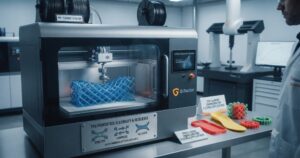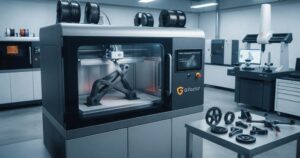
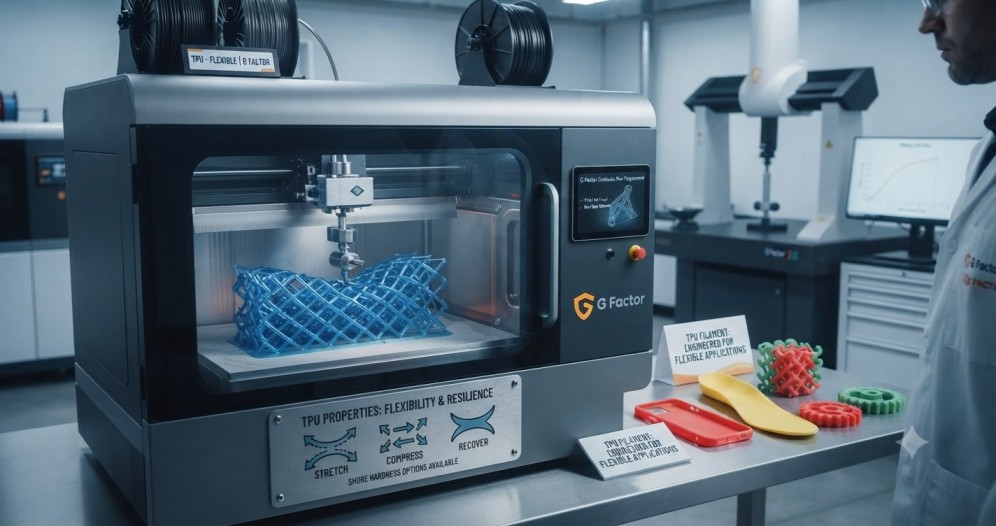
Most standard 3D printing plastics like PLA or ABS produce rigid, stiff parts that break or snap under heavy bending. But what if you need to 3D print a flexible rubber boot, a shock-absorbing vibration damper, or a custom airtight seal?
That is where TPU filament comes in.
TPU (Thermoplastic Polyurethane) is the most popular flexible material used in additive manufacturing today. It combines the elasticity of rubber with the ease of processing found in traditional engineering thermoplastics.
In this comprehensive guide, we will cover what TPU filament is, its key physical properties, popular applications, how it compares to other materials, and best practices for printing it successfully on your shop floor or workshop.
What Is TPU Filament?
TPU stands for Thermoplastic Polyurethane. It belongs to the family of Thermoplastic Elastomers (TPE). Unlike thermoset rubbers that require chemical vulcanization, TPU melts when heated and solidifies when cooled, making it ideal for 3D printing.
When processed into 3D printer filament, TPU creates parts that can stretch, bend, compress, and absorb heavy impacts without deforming permanently or cracking.
To explore where TPU fits into the broader ecosystem of industrial polymers, review our complete guide to 3D Printing Materials.
Key Properties and Features of TPU
TPU filament is widely specified across automotive, medical, and consumer product design due to its unique physical characteristics:
-
High Elasticity: TPU parts can stretch significantly beyond their original length and bounce back to their original shape without permanent deformation.
-
Exceptional Impact Resistance: Because it absorbs energy rather than resisting it rigidly, TPU is virtually unbreakable under sudden physical impacts.
-
Chemical & Oil Resistance: TPU resists breakdown from industrial oils, greases, fuels, and many chemical solvents, making it a staple for factory environments.
-
Abrasion Resistance: It possesses superior wear resistance compared to standard plastics, making it ideal for high-friction applications like wheels and shoe soles.
-
Shore Hardness Variability: TPU is rated on the Shore Hardness scale (typically Shore 85A to 95A for 3D printing). Lower numbers (e.g., 85A) mean softer, more flexible parts, while higher numbers (e.g., 95A) mean firmer, semi-rigid parts.
What Is TPU Filament Used For? Real-World Applications
Because TPU bridges the gap between rubber and plastic, it is used across a wide variety of industries to produce functional end-use parts. Learn more about how different sectors deploy flexible materials in our 3D Printing Industries Overview.
-
Automotive & Transportation: Flexible wiring grommets, protective dust boots, bumper pads, and vibration-dampening engine mounts. Explore dedicated solutions under Automotive 3D Printing.
-
Industrial Tooling & Robotics: Custom suction cups, non-marring soft jaws, drive belts, and protective end-of-arm tooling grippers.
-
Medical & Orthotics: Custom flexible orthotic shoe insoles, patient-matched bracing pads, and prosthetic liners. Discover more under Medical 3D Printing.
-
Consumer Goods: Durable phone cases, protective camera bumpers, flexible drone landing gear, watch bands, and footwear prototypes.
FFF vs. FGF for Flexible TPU Printing
While flexible materials are commonly used in spooled filament format, industrial setups also utilize bulk TPU pellets:
-
Fused Filament Fabrication (FFF): Spooled TPU filament is perfect for detailed gaskets, phone cases, and small dampeners. Explore precision filament options in our catalog of FFF 3D Printers, including compact platforms like the G220 and G300 Pro, as well as large-format systems like the GM1000 1.75mm.
-
Fused Granular Fabrication (FGF / Pellet Extrusion): For large-scale flexible items like outdoor seating cushions or automotive crash pads, pellet extrusion lowers material costs and increases throughput. Check out bulk pellet machines in our list of FGF Pellet 3D Printers, such as the JS-FGF-800Pro.
You can browse all feedstock formats across our dedicated catalogs for FFF Filament Materials and FGF Pellet Materials.
5 Essential Tips for Printing TPU Successfully
Because flexible filament is soft, feeding it through a 3D printer can be like trying to push a wet noodle through a tube. Follow these guidelines for smooth results:
-
Use a Direct-Drive Extruder: Bowden tube setups (where the extruder motor is far from the hotend) often cause TPU to buckle or bind inside the tube. Direct-drive extruders push the filament directly into the hotend, offering far superior control.
-
Print Slowly: Reduce print speeds to 15–30 mm/s. Slow, consistent extrusion prevents filament binding and pressure buildup inside the nozzle.
-
Minimize or Disable Retraction: Rapid retraction movements can cause flexible filament to wrap around the extruder gears. Keep retraction speeds slow and distances minimal.
-
Dry Your Filament: TPU is highly hygroscopic (it rapidly absorbs moisture from the air). Wet TPU produces popping sounds, stringing, and weak layer adhesion. Always dry TPU before printing.
-
Adjust Initial Layer Gap: TPU sticks very well to build surfaces like PEI or glass. Ensure your nozzle isn’t set too close to the bed, or the print may fuse to the bed permanently.
Frequently Asked Questions (FAQ)
Is TPU filament hard to print?
TPU is slightly more challenging to print than PLA or PETG because of its flexibility. However, with a direct-drive extruder, slow print speeds, and dry filament, TPU prints reliably with excellent layer bonding. Have more general questions? Check out our GFac FAQ Page.
What is the difference between TPU and TPE?
TPE (Thermoplastic Elastomer) is a broad category of rubber-like materials. TPU (Thermoplastic Polyurethane) is a specific type of TPE that is slightly firmer, easier to print, and offers better resistance to abrasion and chemicals.
Can you print TPU on a standard 3D printer?
Yes, as long as your printer’s extruder pathway is tightly constrained so the flexible filament cannot buckle. Direct-drive extruders handle TPU much better than Bowden systems.
Key Takeaways
-
Rubber-Like Flexibility: TPU filament offers high elasticity, impact resistance, and durability, making it the top choice for flexible parts.
-
Wide Industrial Utility: Used extensively for gaskets, boots, seals, orthotics, and dampeners across automotive, industrial, and medical sectors.
-
Print Calibration Required: Requires slow print speeds, dried material, and ideally a direct-drive extruder for optimal results.
Explore Advanced 3D Printing Solutions
Whether you need high-precision flexible components or heavy-duty industrial production machines, selecting the right material and hardware is key to manufacturing success.
To learn more about additive manufacturing options, browse all GFac Products, learn more About GFac, read expert guides on our 3D Printing Blog, or Contact Our Engineering Team today for custom recommendations. You can also review our Privacy Policy to see how we protect your project data.