What is FFF printing, and why is it one of the most widely used technologies in modern additive manufacturing?
FFF 3D printing (Fused Filament Fabrication) is a layer-by-layer manufacturing process that uses thermoplastic filament to create physical objects from a digital design. It is one of the most accessible, scalable, and widely adopted forms of 3D printing in both industrial production and prototyping environments.
In industrial settings like those at GFac Industrial 3D Printing Solutions, FFF technology is used to produce functional prototypes, engineering components, and large-format parts with high precision and repeatability.
This guide explains everything you need to know about FFF printing—from how it works, to materials, advantages, limitations, and real-world applications.
What is FFF 3D Printing?
FFF (Fused Filament Fabrication) is an additive manufacturing process where a continuous filament of thermoplastic material is melted and extruded through a heated nozzle.
The material is deposited layer by layer until the final object is formed.
In simple terms:
It works like a hot glue gun controlled by a computer, building objects from the bottom up with extreme precision.
FFF is sometimes referred to as:
- FDM (Fused Deposition Modeling)
- Material extrusion 3D printing
- Thermoplastic additive manufacturing
However, FFF is the open-source industrial term widely used in engineering and manufacturing industries.
Why FFF Printing Matters in Industry
FFF technology is popular because it balances:
- Cost efficiency
- Material versatility
- Mechanical performance
- Ease of production
Industries use FFF printing for:
- Rapid prototyping
- Functional testing
- Custom tooling
- End-use production parts
At GFac FFF Industrial Systems, advanced large-format machines extend FFF capabilities to industrial-scale manufacturing.
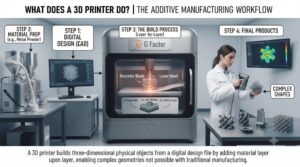
How FFF 3D Printing Works (Step-by-Step)
Understanding the workflow helps explain why FFF is so widely used.
Step 1: 3D Model Design
Everything starts with a digital CAD model created using tools like:
- SolidWorks
- Fusion 360
- AutoCAD
- Rhino
The design defines:
- Shape
- Dimensions
- Mechanical properties
- Structural requirements
Step 2: Slicing the Model
The model is converted into layers using slicing software.
This process generates:
- Toolpaths
- Print speed settings
- Layer height
- Temperature control
The output is G-code, which the printer follows.
Step 3: Loading Filament Material
FFF printers use thermoplastic filament such as:
- PLA
- ABS
- PETG
- Nylon
At FFF Filament Materials, industrial-grade polymers and composites are used for stronger mechanical performance.
Step 4: Heating and Extrusion
The printer heats the filament to a molten state (typically 190°C–260°C depending on material).
Then it is pushed through a nozzle.
Step 5: Layer-by-Layer Printing
The material is deposited in thin layers:
- Each layer bonds with the previous one
- The object gradually takes shape
- Cooling solidifies each layer
This continues until the object is complete.
Step 6: Cooling and Finishing
After printing:
- The part is cooled
- Supports are removed
- Surface finishing may be applied
Key Components of an FFF Printer
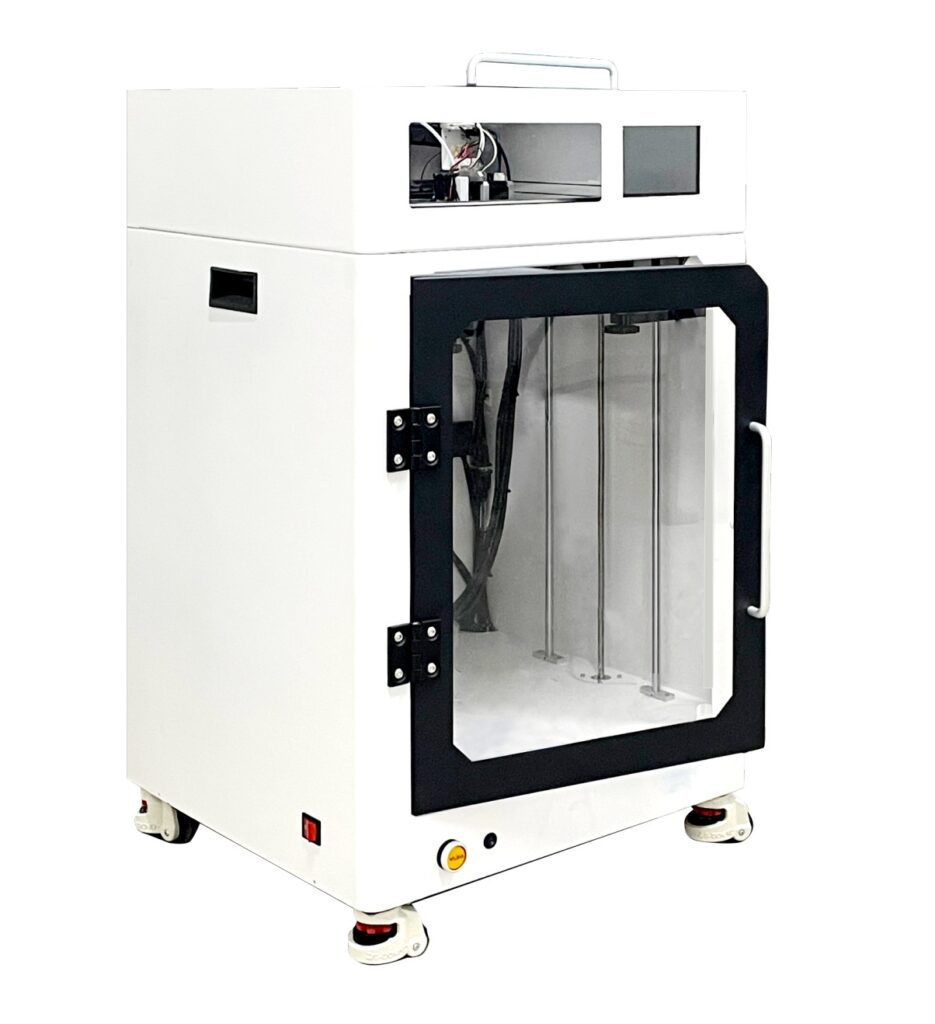
An industrial FFF system includes:
- Extruder (melts filament)
- Nozzle (controls flow)
- Heated bed (improves adhesion)
- Motion system (controls movement)
- Control board (processes instructions)
Industrial systems like those at GFac also include:
- Closed-loop servo motors
- Auto-leveling systems
- High-temperature nozzles
- Large build volumes
Materials Used in FFF Printing
Material selection is critical for performance.
Common Thermoplastics
PLA (Polylactic Acid)
- Easy to print
- Biodegradable
- Low warping
Used for prototypes and visual models.
ABS (Acrylonitrile Butadiene Styrene)
- Strong and durable
- Heat resistant
- Impact resistant
Used in automotive and industrial parts.
PETG
- Chemical resistant
- Strong and flexible
- Waterproof
Used for functional components.
Nylon
- High strength
- Wear resistant
- Flexible
Used in engineering applications.
Carbon Fiber Composites (PLA-CF, Nylon-CF)
- High stiffness
- Lightweight
- Industrial strength
Used in aerospace and automotive applications.
Advantages of FFF 3D Printing
FFF is widely adopted because of its benefits:
1. Cost Efficiency
Lower material and machine costs compared to other technologies.
2. Material Flexibility
Supports a wide range of thermoplastics.
3. Easy Production
Simple workflow from design to product.
4. Scalable Manufacturing
Works for both prototypes and production parts.
5. Fast Iteration
Design changes can be printed immediately.
Limitations of FFF Printing
Despite its advantages, FFF has some limitations:
- Layer lines visible on surface
- Lower resolution compared to SLA
- Strength varies by print orientation
- Requires tuning for best results
However, industrial systems significantly reduce these issues.
Industrial Applications of FFF Printing
FFF is used across multiple industries.
Automotive Industry
Applications include:
- Functional prototypes
- Custom brackets
- Interior components
- Testing fixtures
Benefits:
- Faster development cycles
- Reduced tooling costs
Aerospace Industry
Used for:
- Lightweight parts
- Testing models
- Engineering prototypes
Benefits:
- Weight reduction
- Rapid design validation
Architecture and Design
Used for:
- Building models
- Concept visualization
- Structural mockups
Benefits:
- Fast iteration
- Complex geometry support
Medical Industry
Used for:
- Surgical models
- Educational anatomy models
- Custom devices
Benefits:
- Patient-specific customization
Industrial Manufacturing
Used for:
- Jigs and fixtures
- Tooling
- Spare parts
Benefits:
- On-demand production
- Reduced downtime
FFF vs FGF Printing (Quick Insight)
| Feature | FFF | FGF |
|---|---|---|
| Material | Filament | Pellets |
| Cost | Moderate | Lower |
| Scale | Medium | Large |
| Speed | Medium | High |
| Use Case | Precision parts | Large industrial parts |
For large-scale production, FGF systems are often preferred, such as those at GFac FGF Systems.
Real Industrial Insight (Practical Example)
A manufacturing company using FFF printing can produce:
- Functional prototypes within 24–48 hours
- Custom jigs without machining
- Small-batch production without molds
This drastically reduces lead time compared to traditional CNC workflows.
Future of FFF 3D Printing
FFF technology is evolving toward:
- AI-optimized printing parameters
- Hybrid manufacturing systems
- Smart factory integration (Industry 4.0)
- Stronger composite materials
- Faster extrusion systems
Large industrial systems like GFac machines are pushing FFF beyond prototyping into real production environments.
Frequently Asked Questions (FAQ)
What is FFF 3D printing?
FFF is a manufacturing process where melted thermoplastic filament is deposited layer by layer to create objects.
Is FFF the same as FDM?
Yes, FDM and FFF are essentially the same technology with different naming conventions.
What materials are used in FFF printing?
Common materials include PLA, ABS, PETG, Nylon, and carbon-fiber composites.
What are the advantages of FFF printing?
It is cost-effective, flexible, easy to use, and suitable for rapid prototyping and production.
Where is FFF printing used?
It is used in automotive, aerospace, medical, architecture, and industrial manufacturing sectors.
Summary
FFF 3D printing (Fused Filament Fabrication) is one of the most important technologies in modern additive manufacturing. It enables fast, flexible, and cost-effective production of functional parts using thermoplastic materials.
From simple prototypes to industrial components, FFF printing continues to transform how products are designed and manufactured.
At GFac Singapore, advanced FFF systems are helping industries scale production, improve efficiency, and accelerate innovation in real-world manufacturing environments.