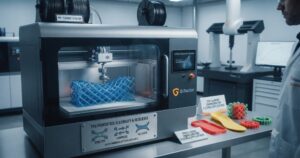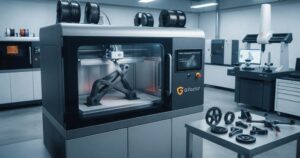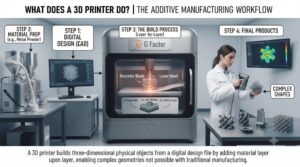
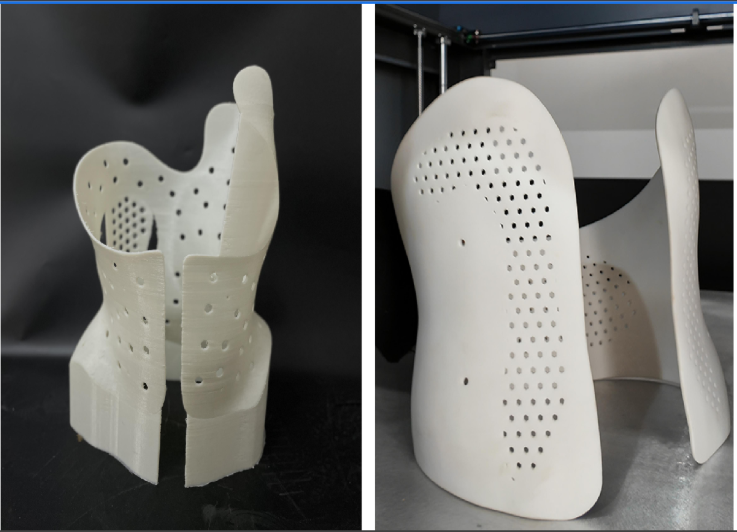
The healthcare sector is currently witnessing a paradigm shift: the transition from “mass-produced” standard medical devices to “patient-specific” precision care. Medical 3D printing is the cornerstone of this evolution. By leveraging high-resolution additive manufacturing, medical professionals can now move beyond static anatomical models to creating functional, patient-tailored orthotics, prosthetic limbs, and surgical guides that match the exact morphology of an individual.
At G Factor, we provide the advanced industrial technology necessary to turn complex patient scan data into life-changing medical solutions. Whether you are producing lightweight braces or complex diagnostic tools, our medical 3D printer systems are designed for the high precision and material reliability the medical field demands.
1. The Power of Personalized Medicine
In traditional orthopedics, patients often have to wait weeks for a device that is “close enough” to their anatomy. This usually involves messy plaster casting and manual adjustments that often result in uncomfortable fits, poor ventilation, and limited mobility.
Medical 3D printing flips this workflow. By utilizing 3D patient scan data—such as high-resolution MRI or CT data converted into a digital model—we can design an orthotic or prosthetic that contours perfectly to the patient’s body.
Why Digital Fabrication Wins:
-
Perfect Fit: Devices match the exact shape of a patient’s limb or skeletal structure.
-
Breathability: We can print complex lattice structures that are lightweight and perforated, preventing skin irritation and sweat accumulation.
-
Rapid Turnaround: From a digital scan to a finished, functional device in 24–48 hours, versus weeks of traditional fabrication.
2. Choosing the Right Technology: FFF vs. FGF for Medical Applications
In the medical space, resolution and material properties are non-negotiable. G Factor offers two primary workflows to accommodate different needs:
High-Precision FFF (Filament-Based)
Our FFF (Fused Filament Fabrication) series is ideal for applications requiring fine-tuned precision and complex geometry. The ability to use specialized FFF filament materials—including medical-grade PETG and tough, skin-friendly Nylon—makes these printers the perfect choice for:
-
Surgical Guides: Assisting surgeons with precise drill trajectories during complex operations.
-
Anatomical Models: Allowing surgeons to practice on 1:1 replicas of a patient’s heart, spine, or femur before stepping into the operating room.
-
Prosthetic Components: Creating durable, lightweight fittings that connect to traditional prosthetic assemblies.
Structural FGF (Pellet-Based)
For larger medical devices or highly durable components, our FGF (Fused Granular Fabrication) technology provides the ability to print larger, more robust structural elements with extreme speed and lower material costs by using FGF pellet materials.
3. Engineering for Patient Comfort: The Role of Lattice Structures
One of the most significant advantages of additive manufacturing in healthcare is the ability to print Topology-Optimized Lattice Structures.
Unlike solid, injected-molded plastic that traps moisture and heat, a 3D-printed brace can feature an internal web of structural struts. These lattices can be engineered to be stiff where the patient needs support, and flexible where they need mobility.
-
Weight Reduction: Lattice designs can cut the weight of a prosthetic device by up to 60%, significantly reducing patient fatigue.
-
Enhanced Skin Health: The “open” structure allows for airflow, which is critical for patients who must wear orthotics for extended periods.
4. Comparing Traditional Fabrication vs. G Factor Solutions
| Metric | Traditional Casting/Fabrication | G Factor 3D Printing Solution |
| Lead Time | 2–4 Weeks | 24–48 Hours |
| Customization | Low (Generic sizing) | 100% Patient-Specific |
| Breathability | Poor (Solid shell) | High (Lattice architecture) |
| Material Waste | High (Plaster/excess resin) | Minimal (Additive only) |
| Mechanical Strength | Variable (Manual skill dependent) | Consistently High (Digital control) |
5. Ensuring Material Safety and Reliability
The medical field requires materials that are not only mechanically sound but also safe for prolonged skin contact. G Factor’s open-material philosophy allows clinics to select certified materials that meet specific mechanical stress requirements.
Whether it is the toughness required for a prosthetic socket or the chemical resistance needed for medical device enclosures, we provide the technical data sheets required for clinical verification.
6. Frequently Asked Questions (FAQ)
How accurate is 3D printing for anatomical models?
With our industrial FFF series, we can achieve layer resolutions down to 0.05mm. This allows for extremely high-fidelity models that capture even the fine anatomical details required for pre-surgical planning.
Is it difficult to integrate 3D printing into a clinic?
Not at all. Once you have a 3D scanner, the transition to digital workflows is straightforward. Our about us page details how we provide support and integration services to institutions across Asia to ensure your team is ready for high-precision output.
Can we print prosthetics that are as strong as traditional ones?
Yes. By using advanced materials like PA-CF (Nylon Carbon Fiber) or PETG, we can produce parts with tensile strengths exceeding 60 MPa, often outperforming the traditional plastics used in conventional orthotics.
How do we start implementing medical 3D printing in our hospital?
The best way to start is by reviewing our medical 3D printer range. From there, you can contact our team to discuss your specific medical application, material needs, and volume requirements.
7. Looking Toward the Future of Healthcare
The integration of 3D printing into clinical workflows is no longer a “future” concept; it is happening now. From custom braces that prevent atrophy to surgical guides that shorten operating times, the impact on patient outcomes is measurable and significant.
Key Takeaways for Healthcare Professionals:
-
Precision: Move from standard sizing to individualized fit.
-
Efficiency: Reduce the time from scan to treatment by days or weeks.
-
Innovation: Utilize lattice structures to improve patient comfort and compliance.
Ready to Upgrade Your Clinical Workflow?
Whether you represent a hospital, a research institution, or an orthotic clinic, G Factor provides the industrial-grade machinery to lead the way in medical manufacturing. Explore our full range of solutions on our homepage or contact us directly to start your digital transformation.