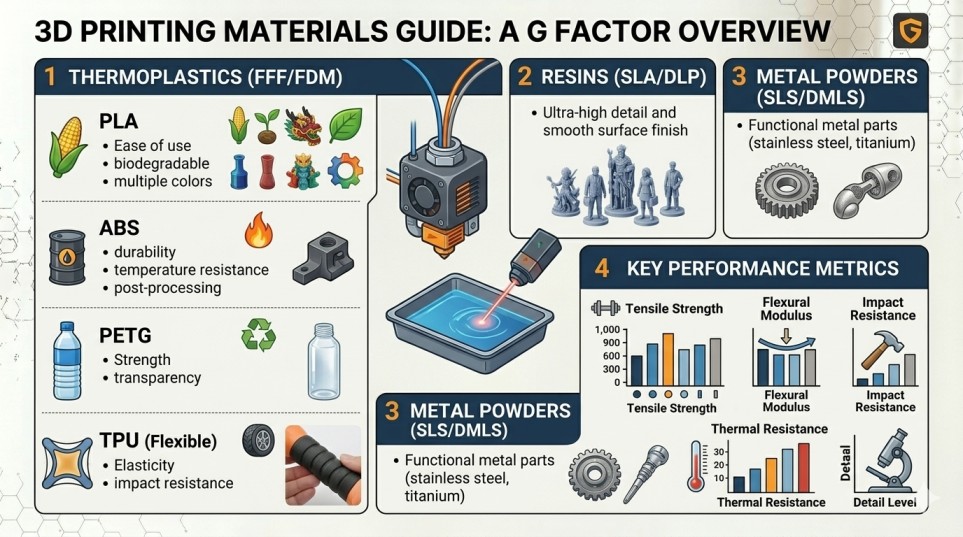
Picking the wrong 3D printing material is one of the most expensive mistakes in additive manufacturing — and it’s more common than most manufacturers admit. A structural bracket printed in PLA instead of PA+GF fails under load. A marine component in standard ABS degrades in weeks from UV and saltwater exposure. This complete 3D printing materials guide covers every major filament and pellet option available for FFF and FGF systems: what each material does well, where it falls short, which industries actually use it, and how to match material properties to real production requirements. Whether you’re printing desktop prototypes or large-format industrial molds, this guide gives you the technical foundation to choose confidently.
Why Material Selection Matters More Than Printer Selection
Most beginners focus on printer specifications — build volume, layer resolution, print speed. Experienced engineers focus on material first.
The reason is straightforward: the printer is a tool. The material is what your finished part is made of. A $500,000 industrial FGF system printing the wrong pellet compound produces scrap just as reliably as a $500 desktop printer would.
Material selection determines:
- Mechanical strength — can the part handle load, vibration, and impact?
- Thermal performance — will it deform under heat?
- Chemical resistance — will it survive exposure to oils, solvents, or moisture?
- Printability — does it require a heated enclosure, specialized nozzle, or drying?
- Post-processing requirements — does it sand, paint, or bond well?
- Cost per kilogram — how does material cost affect production economics?
The two material formats in additive manufacturing — filament (for FFF systems) and pellets/granules (for FGF systems) — share many base polymers but differ significantly in cost, availability, and production suitability.
FFF Filament Materials: The Complete Breakdown
FFF (Fused Filament Fabrication) printers feed pre-manufactured filament — typically 1.75mm or 3.5mm diameter spools — through a heated nozzle. The quality and consistency of the filament directly affects print outcome.
Explore GFac’s FFF filament printer systems
GFac’s FFF range supports four core filament materials across its full printer lineup, from the entry-level G220 through to the GM1000 large-format system. Here’s what each one actually delivers.
PLA — The Most Beginner-Friendly Material in 3D Printing
Definition: PLA (Polylactic Acid) is a bio-based thermoplastic derived from renewable resources such as corn starch or sugarcane. It’s the most widely used filament material globally.
Print temperature: 190–230°C
Bed temperature: 50–70°C
Tensile strength: 40–60 MPa
Max print speed: Up to 350mm/s
PLA is the default choice for prototyping, creative work, and any application where heat resistance isn’t a concern. It has the lowest shrinkage rate of common filament materials, which means parts come off the bed dimensionally accurate with minimal warping — even on open-frame printers without enclosures.
Where PLA excels:
- Consumer product prototypes
- Architectural scale models
- Cultural, creative, and educational applications
- High-speed production of display props
- Museum and exhibition pieces
Where PLA falls short:
- Heat resistance is limited to approximately 55–60°C — unsuitable for under-hood automotive or any application with elevated temperatures
- Lower impact resistance compared to ABS or PETG
- Not suitable for outdoor long-term use without UV-stabilized formulations
Expert insight: PLA’s speed advantage is real. At up to 350mm/s on GFac FFF systems, PLA can produce finished display-quality parts faster than most other materials — making it the logical choice when time-to-part matters more than mechanical performance.
[Image Suggestion: PLA parts in multiple colors — cultural props, architectural models, consumer product prototypes]
ABS — The Engineering Standard for Tough, Heat-Resistant Parts
Definition: ABS (Acrylonitrile Butadiene Styrene) is a petroleum-based thermoplastic known for its impact resistance, dimensional stability, and higher heat deflection temperature compared to PLA.
Print temperature: 220–270°C
Bed temperature: 60–80°C
Tensile strength: >43 MPa
Max print speed: Up to 200mm/s
ABS has been an engineering material staple for decades — long before 3D printing. In additive manufacturing, it’s the filament of choice when you need genuine toughness, heat resistance up to approximately 80–100°C, and parts that can be post-processed (machined, sanded, acetone-smoothed) to a production-quality finish.
Where ABS excels:
- Automotive interior components and housings
- Consumer electronics enclosures
- Bicycle helmet inserts and sports equipment
- Functional prototypes requiring thermal stability
- Parts that will be painted or acetone-vapor smoothed
Where ABS falls short:
- Warping during printing requires an enclosed, temperature-controlled print environment
- Emits fumes during printing — adequate ventilation is essential
- Lower layer adhesion than PETG under certain conditions
- Print speed ceiling is lower than PLA
Printer requirement: For reliable ABS printing, use an enclosed printer. GFac’s larger FFF models (G610, GM1000) with their closed chambers handle ABS more consistently than open-frame machines.
PETG — The Best All-Rounder for Functional Parts
Definition: PETG (Polyethylene Terephthalate Glycol-modified) is a modified version of the PET plastic used in water bottles, engineered for improved printability and toughness versus standard PET.
Print temperature: 220–250°C
Bed temperature: 60–80°C
Tensile strength: >51 MPa
Max print speed: Up to 200mm/s
PETG sits at a genuinely useful middle ground between PLA’s ease and ABS’s toughness. It’s chemically resistant, waterproof, food-contact safe in certain formulations, and tough enough to flex without shattering under impact — a failure mode that affects both PLA and ABS in thin-wall geometries.
Where PETG excels:
- Medical device prototypes and anatomical models
- Automotive parts requiring moisture resistance
- Electronic housings and enclosures
- Containers, ducts, and fluid-handling components
- Outdoor applications with moderate UV exposure
Where PETG falls short:
- Tendency to string between points if retraction isn’t tuned correctly
- Not as rigid as PLA-CF or ABS for structural applications
- Slightly hygroscopic — absorbs moisture from air, which can cause print quality issues if stored improperly (dry filament before printing)
Practical tip: Store PETG in a sealed container with desiccant between print sessions. Moisture-absorbed PETG produces bubbles and surface roughness that are often misdiagnosed as temperature or speed problems.
PLA-CF — Carbon Fiber Reinforced Filament for Structural Performance
Definition: PLA-CF is standard PLA compounded with short carbon fiber strands, dramatically increasing stiffness and tensile strength while retaining PLA’s low-warp printability.
Print temperature: 190–220°C
Bed temperature: 50–70°C
Tensile strength: 65 MPa
Max print speed: Up to 200mm/s
PLA-CF represents the performance ceiling of PLA-family materials. With tensile strength of 65 MPa — significantly higher than standard PLA’s 40–60 MPa — it produces parts stiff enough for jigs, fixtures, tooling aids, and structural brackets where standard PLA would flex or fail.
Where PLA-CF excels:
- Production jigs and fixtures
- Lightweight structural components
- Drone frames and aerospace ground support equipment
- Industrial tooling aids
- High-strength prototypes for load testing
Where PLA-CF falls short:
- Nozzle wear is a serious consideration — the carbon fiber strands are abrasive and will erode standard brass nozzles in hours. Always use hardened steel nozzles when printing CF-reinforced materials
- Lower layer adhesion than standard PLA in the Z-direction (between layers)
- Heat resistance ceiling remains similar to standard PLA
Explore GFac’s full FFF filament materials range
FFF Filament Materials Comparison Table
| Material | Print Temp | Tensile Strength | Max Speed | Heat Resistance | Key Strength | Main Limitation |
|---|---|---|---|---|---|---|
| PLA | 190–230°C | 40–60 MPa | 350mm/s | ~60°C | Easy to print, fast | Low heat resistance |
| ABS | 220–270°C | >43 MPa | 200mm/s | ~100°C | Tough, heat resistant | Warping, needs enclosure |
| PETG | 220–250°C | >51 MPa | 200mm/s | ~80°C | Chemical/water resistant | Strings; moisture-sensitive |
| PLA-CF | 190–220°C | 65 MPa | 200mm/s | ~60°C | Highest stiffness | Abrasive; needs steel nozzle |
FGF Pellet Materials: Industrial-Grade Compounds for Large-Scale Production
FGF (Fused Granular Fabrication) systems use raw plastic pellets — the same feedstock used in injection molding — processed through a screw extrusion system to deposit material at significantly higher rates than filament-based machines.
The cost advantage is substantial: pellets typically cost 40–60% less per kilogram than equivalent filament. For manufacturers running large-format FGF printers producing parts with 10–100+ kg of material per print, this translates directly to production economics.
Explore GFac’s FGF pellet printing systems
GFac’s FGF systems support ten pellet material families, covering applications from flexible sealing components to extreme-temperature aerospace parts.
[Image Suggestion: Variety of pellet material samples in labeled containers — ABS, TPU, PC+CF, PA+GF, PPS+CF]
ABS Pellets — The Industrial Workhorse
ABS in pellet form brings all the mechanical and thermal properties of ABS filament at significantly lower cost per kilogram. For automotive manufacturers using large-format FGF systems to print bumper tooling, interior trim molds, or full-scale body panels, ABS pellets are the most common starting point.
Typical applications:
- Automotive exterior and interior prototypes
- Large housings and enclosures
- Tooling and fixturing for production lines
- Event display props requiring paint adhesion
TPU Pellets — The Flexible Material Option
Definition: TPU (Thermoplastic Polyurethane) is an elastomeric material combining rubber-like flexibility with thermoplastic processability.
TPU pellets fill the gap that rigid materials can’t. Seals, gaskets, grips, soft-touch surfaces, and any component that needs to flex, compress, and return to shape falls into TPU territory.
Typical applications:
- Industrial seals and gaskets
- Anti-vibration mounts
- Grip surfaces and ergonomic components
- Footwear midsole prototypes
- Marine component seals
Printing consideration: TPU requires careful extrusion control — it’s prone to buckling in standard extruder designs. GFac’s screw extrusion FGF systems handle TPU pellets more consistently than many filament-based setups because the screw mechanism controls flow rate directly.
PC+CF — High Stiffness and Strength for Structural Industrial Parts
Definition: PC+CF is Polycarbonate compounded with carbon fiber, delivering exceptional rigidity, impact resistance, and dimensional stability at elevated temperatures.
Polycarbonate alone is already a high-performance engineering material — used in bulletproof glazing, aircraft canopies, and medical device housings. Adding carbon fiber reinforcement pushes stiffness further while keeping weight low.
Typical applications:
- Aerospace interior structural components
- Autoclave mold tooling
- High-performance automotive brackets
- Structural drone frames
- Industrial fixtures requiring thermal stability
Temperature performance: PC+CF maintains structural integrity at temperatures where PLA-family materials would deform, making it suitable for end-use parts in thermally demanding environments.
PA+GF — Nylon with Glass Fiber for Heat-Resistant Production Parts
Definition: PA+GF is Polyamide (Nylon) reinforced with glass fiber, producing a material with excellent heat resistance, stiffness, and fatigue resistance.
Nylon’s inherent toughness combined with glass fiber reinforcement creates a material that handles both thermal stress and mechanical cycling — critical for under-hood automotive parts, manufacturing tooling, and any application where a part experiences repeated load cycles over time.
Typical applications:
- Under-hood automotive components
- Industrial conveyor parts
- Heat-resistant tooling and jigs
- Structural brackets in warm environments
- Marine components exposed to heat
Important note: PA (Nylon) is hygroscopic — it absorbs moisture aggressively. Pellets must be dried before printing, and parts in humid environments may experience dimensional changes. GFac’s FGF systems with heated hopper options help manage moisture absorption during the print process.
PP+GF — Chemical Resistance and Durability for Marine and Industrial Use
Definition: PP+GF is Polypropylene reinforced with glass fiber — delivering chemical resistance, low density, and good fatigue performance.
Polypropylene is used extensively in chemical handling equipment, automotive fuel systems, and food processing machinery because of its exceptional resistance to acids, bases, and most industrial solvents. Glass fiber reinforcement adds the stiffness that standard PP lacks.
Typical applications:
- Marine component prototypes and small-batch production
- Chemical industry ducting and fixtures
- Food processing equipment housings
- Automotive fuel system components
- Fluid-handling industrial parts
PETG Pellets and PETG+GF — Balanced Performance at Scale
PETG in pellet form delivers the same chemical resistance, toughness, and moisture resistance as PETG filament — but at the material cost economics of FGF pellet production. PETG+GF adds glass fiber reinforcement for applications needing higher stiffness.
Typical applications:
- General industrial components
- Medical device enclosures
- Outdoor signage and display structures
- Large containers and storage components
PESU+CF — High-Performance Engineering Polymer for Demanding Applications
Definition: PESU (Polyethersulfone) is a high-performance engineering thermoplastic with continuous use temperatures up to 180–200°C. CF reinforcement adds structural rigidity.
PESU+CF is in a different performance category from commodity polymers. It maintains mechanical properties at temperatures where ABS, PETG, and standard nylon would have long since deformed. This material is specified in aerospace, defense, and medical applications where failure is not an option and operating conditions are severe.
Typical applications:
- Aerospace interior structural components
- High-temperature industrial fixtures
- Medical autoclave-compatible tooling
- Defense equipment housings
Cost consideration: PESU+CF pellets are significantly more expensive than commodity materials like ABS or PLA. They’re specified when performance requirements justify the cost — not as a general-purpose choice.
PPS+CF — Extreme Chemical and Thermal Resistance
Definition: PPS (Polyphenylene Sulfide) is an ultra-high-performance polymer with exceptional resistance to chemicals, high temperatures (continuous use to 220°C+), and flame.
PPS+CF is the material choice when almost nothing else will survive. Chemical processing equipment, semiconductor manufacturing components, and aerospace structural parts in high-temperature zones are its natural domain.
Typical applications:
- Chemical industry corrosion-resistant components
- Semiconductor equipment parts
- Aerospace structural parts in engine proximity zones
- High-temperature electrical components
Explore GFac’s full FGF pellet materials range
FGF Pellet Materials Comparison Table
| Material | Key Properties | Heat Resistance | Chemical Resistance | Typical Industries |
|---|---|---|---|---|
| ABS Pellets | Impact-resistant, durable | ~100°C | Moderate | Automotive, display, tooling |
| TPU Pellets | Flexible, elastic | ~80°C | Good | Marine seals, grips, footwear |
| PC+CF | High rigidity, impact strength | ~130°C | Moderate | Aerospace, automotive |
| PA+GF | Heat resistant, fatigue resistant | ~150°C | Moderate | Under-hood auto, tooling |
| PP+GF | Chemical resistant, low density | ~120°C | Excellent | Marine, chemical, food |
| PETG Pellets | Balanced, waterproof | ~80°C | Good | General industrial, medical |
| PETG+GF | Stiffer PETG, balanced | ~90°C | Good | Industrial enclosures |
| PESU+CF | High-temp engineering | ~200°C | Very good | Aerospace, defense, medical |
| PPS+CF | Extreme thermal/chemical | ~220°C+ | Excellent | Chemical, semiconductor, aero |
How to Choose the Right 3D Printing Material: A Decision Framework
[Image Suggestion: Flowchart — Material Selection Decision Tree based on temperature, load, environment]
The right material emerges from answering four questions about your application:
1. What is the maximum operating temperature?
- Below 60°C → PLA, PETG, PLA-CF
- 60–100°C → ABS, PETG+GF, PP+GF
- 100–150°C → PA+GF, PC+CF
- 150–200°C → PESU+CF
- 200°C+ → PPS+CF
2. What mechanical loads will the part experience?
- Primarily static / display → PLA, PETG, ABS
- Dynamic / cyclic fatigue → PA+GF, PC+CF
- Impact-critical → ABS, PC+CF, TPU (flexible zones)
- Maximum stiffness → PLA-CF, PC+CF, PESU+CF
3. What chemical or environmental exposure will occur?
- Indoor, dry → PLA, ABS, PETG
- Moisture / outdoor → PETG, PP+GF, PPS+CF
- Acids, solvents → PP+GF, PPS+CF
- UV exposure long-term → PP+GF (UV-stabilized grade)
4. What is the production scale?
- One-off to small batch → FFF filament (easier material handling)
- Medium to large batch, large parts → FGF pellets (lower material cost per kg)
Contact the GFac team for application-specific material recommendations from engineers experienced across automotive, aerospace, marine, and medical sectors.
Material Storage and Handling: The Details That Affect Print Quality
Even the correct material fails if it’s handled improperly. These principles apply across both filament and pellet systems.
Moisture Control Is Non-Negotiable
Hygroscopic materials — PA (Nylon), PETG, PC, PESU, PPS — absorb moisture from ambient air. Wet material produces:
- Surface bubbling and rough texture
- Reduced layer-to-layer bond strength
- Dimensional inaccuracy
- Popping and crackling sounds during extrusion
Solution: Dry filaments and pellets before printing. Filaments typically require 4–8 hours in a drying oven at 65–80°C depending on material type. GFac’s FGF systems with automatic feeders and hopper systems help maintain material condition during extended print runs.
Nozzle Material Compatibility
| Filament/Pellet Material | Required Nozzle Type |
|---|---|
| PLA, PETG (unfilled) | Brass (standard) |
| ABS, TPU | Brass or hardened steel |
| PLA-CF, PC+CF, PA+GF, PETG+GF | Hardened steel (mandatory) |
| PESU+CF, PPS+CF | Hardened steel or high-alloy tool steel |
Using a standard brass nozzle with carbon fiber or glass fiber-filled materials causes rapid nozzle erosion — measured in hours of print time, not weeks. This is one of the most common and costly maintenance mistakes in industrial additive manufacturing.
Storage Conditions
- Filaments: sealed bags with desiccant, stored away from UV and heat
- Pellets: sealed containers or original bags, elevated off concrete floors (concrete transmits moisture)
- Temperature: room temperature (15–25°C), away from direct sunlight
Material Cost Reality: Filament vs. Pellets at Scale
The cost difference between filament and pellets is significant enough to affect machine selection decisions for manufacturers producing parts at scale.
| Cost Factor | FFF Filament | FGF Pellets |
|---|---|---|
| Typical cost per kg (ABS) | $20–$50 USD/kg | $3–$10 USD/kg |
| Material form | Pre-manufactured spool | Raw industrial granule |
| Sourcing | Specialty 3D printing suppliers | Standard injection molding suppliers |
| Minimum order | Per spool (0.5–5 kg) | Per bag/pallet (25–500+ kg) |
| Material consistency | Manufacturer-controlled | Requires process calibration |
| Cost at 100 kg production | $2,000–$5,000 | $300–$1,000 |
For manufacturers producing parts where material weight is measured in tens of kilograms per print — automotive molds, large sculptures, marine components — the switch from filament to pellets isn’t just cost-efficient; it’s often what makes the production economics viable at all.
Learn how GFac’s large-format 3D printing solutions serve industrial manufacturers across Asia
Real Industry Applications: Which Materials Are Used Where
Automotive Industry
- Prototype tooling and molds: ABS pellets, PA+GF
- Bumper and body panel mockups: ABS filament, ABS pellets
- Under-hood components: PA+GF, PC+CF
- Interior trim prototypes: ABS, PETG
Aerospace and Aviation
- Autoclave mold tooling: PC+CF, PESU+CF
- Interior cabin components: PC+CF, PESU+CF
- Ground support equipment: PLA-CF, PA+GF
- Ducting and non-structural parts: PETG+GF
Marine and Shipbuilding
- Hull form models: ABS, PP+GF
- Marine component prototypes: PP+GF (chemical and saltwater resistance)
- Seals and gaskets: TPU pellets
- Structural tooling: PA+GF
Medical
- Anatomical models: PLA, PETG (biocompatible grades)
- Surgical guides: PLA, PETG
- Sterilizable components: PESU+CF (autoclave-compatible)
- Prosthetic components: PA+GF, TPU
Architecture and Construction
- Facade and curtain wall elements: ABS pellets, PP+GF
- Scale models: PLA, PETG
- Decorative structural elements: ABS, PETG
Sculpture and Events
- Large sculptures: ABS pellets, PLA
- Exhibition props: ABS, PETG
- Branded installations: ABS, PLA (paintable surfaces)
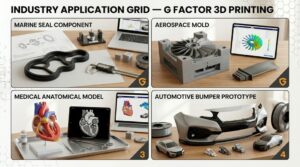
[Image Suggestion: Industry application grid — marine seal component, aerospace mold, medical anatomical model, automotive bumper prototype]
Standards and Certifications: What to Know When Specifying Materials
For regulated industries — aerospace, medical, defense — material selection isn’t just a performance question; it’s a compliance question.
The ASTM International F42 Committee on Additive Manufacturing Technologies publishes standards including ASTM F3091 (powder bed fusion of plastics) and related standards for material testing and qualification. ISO/ASTM 52904 covers process requirements for additive manufacturing.
For medical applications, materials may need to comply with ISO 10993 (biological evaluation of medical devices) if parts come into contact with patients or bodily fluids.
For aerospace, material qualification follows SAE and ASTM standards specific to the part classification and operating environment. The NASA Technical Reports Server provides open-access research on additive manufacturing material performance in aerospace contexts.
Buyers in regulated industries should request material datasheets and traceability documentation from their material supplier, and verify that the additive manufacturing process parameters used are consistent with material qualification data.
Learn more about GFac’s industrial capabilities and material support
FAQ: 3D Printing Materials Questions Answered
Q1: What is the strongest 3D printing material for FFF printers?
Among standard FFF filaments, PLA-CF (carbon fiber reinforced PLA) has the highest tensile strength at 65 MPa. For engineering applications requiring both strength and heat resistance, PC+CF pellets used in FGF systems offer superior structural performance.
Q2: What 3D printing material is heat resistant?
ABS handles up to approximately 100°C. PA+GF (nylon + glass fiber) handles up to ~150°C. PESU+CF is rated for continuous use up to ~200°C. PPS+CF handles 220°C+ in extreme environments.
Q3: Is PETG stronger than ABS?
PETG has higher tensile strength (>51 MPa vs ABS’s >43 MPa) and better chemical resistance. ABS has higher heat resistance and is easier to machine and post-process. For most functional parts not exposed to high temperatures, PETG is the better choice.
Q4: What is the cheapest 3D printing material?
PLA filament is the least expensive FFF material, typically $15–$25 per kg in standard grades. For FGF systems, ABS pellets and PLA pellets are the most economical options, often available for $3–$8 per kg in industrial quantities.
Q5: Can you 3D print with recycled plastic?
FGF pellet systems can process recycled and regrind pellets, provided the material has consistent melt flow characteristics. Standard injection molding regrind is often compatible with FGF extrusion. Filament recycling requires specialized equipment to re-extrude filament from waste material.
Q6: What materials are used for industrial 3D printing molds?
Common mold materials include ABS pellets for basic tooling, PA+GF for heat-resistant molds, PC+CF for structural mold components, and PESU+CF for high-temperature applications like autoclave molds.
Q7: Do I need to dry filament before printing?
For hygroscopic materials — PETG, PA (Nylon), PC, TPU, PESU, PPS — yes, drying is essential. PLA is less moisture-sensitive but benefits from drying after extended storage. Wet material produces bubbles, surface defects, and reduced mechanical properties.
Q8: What is the difference between PA+GF and PC+CF?
PA+GF (Nylon + Glass Fiber) is optimized for fatigue resistance, toughness, and thermal stability — ideal for cyclically loaded parts. PC+CF (Polycarbonate + Carbon Fiber) offers higher rigidity and impact strength, making it better suited for structural components requiring stiffness rather than flexibility.
Q9: What nozzle do I need for carbon fiber materials?
Hardened steel nozzles are mandatory for any carbon fiber (CF) or glass fiber (GF) reinforced material. Standard brass nozzles erode within hours when printing abrasive filled materials, causing diameter inconsistency and print quality degradation.
Q10: Which 3D printing material is best for outdoor use?
PP+GF (Polypropylene + Glass Fiber) offers the best combination of UV stability (in UV-stabilized grades), chemical resistance, and moisture resistance for outdoor applications. PETG performs well in moderate outdoor conditions. Avoid standard PLA for long-term outdoor exposure.
Key Takeaways
- Material selection determines part performance — printer spec is secondary to material properties
- PLA is the best starting point for prototyping and creative work; limited by heat resistance
- ABS delivers heat resistance and toughness for functional parts; requires enclosed printing
- PETG is the most versatile all-rounder — chemical resistant, waterproof, and easy to print
- PLA-CF delivers the highest stiffness in the FFF filament family; always use hardened steel nozzles
- FGF pellets cost 40–60% less per kg than equivalent filament — a major factor at production scale
- PA+GF and PC+CF are the primary choices for structural industrial parts with thermal demands
- PESU+CF and PPS+CF address extreme-environment applications in aerospace, defense, and chemical industries
- Moisture control and nozzle selection are the two most overlooked factors in material performance
- Regulatory industries need to verify material compliance with ASTM, ISO, and sector-specific standards
Ready to Specify the Right Material for Your Application?
Material selection is straightforward when you have the right framework — and technical support makes the difference between a productive first print and weeks of troubleshooting. GFac’s application engineers work with manufacturers across automotive, aerospace, marine, medical, and architectural sectors to match material specifications to real production requirements.
Whether you’re scaling up from filament prototyping to FGF pellet production, or specifying high-performance compounds for regulated aerospace or medical applications, the team at GFac can provide material datasheets, print parameter guidance, and machine recommendations.