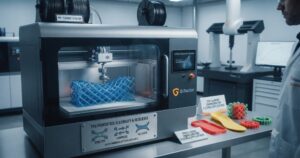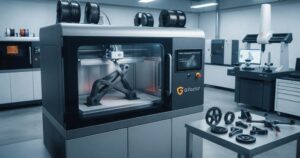
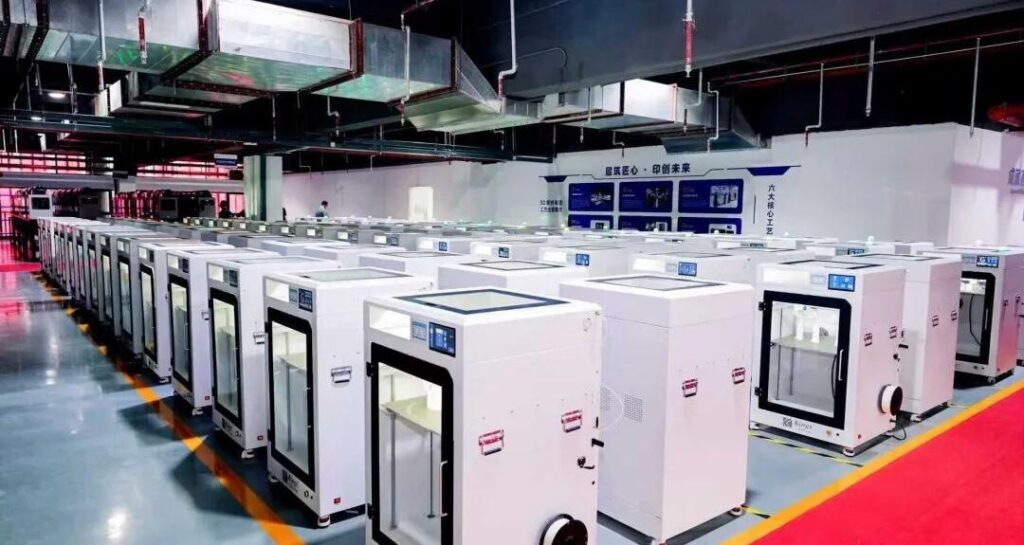
Industrial 3D printing explained in simple terms: it is a manufacturing method that builds real physical parts layer by layer from a digital file using advanced machines, engineering-grade materials, and automated production systems.
In today’s manufacturing world, companies are shifting from traditional subtractive methods (like CNC machining and injection molding) to additive manufacturing because it reduces cost, speeds up production, and enables complex geometries that were previously impossible.
At GFac Industrial 3D Printing Solutions, large-format FFF and FGF systems are designed specifically for industrial production—supporting automotive, aerospace, architecture, marine, and tooling industries with scalable, cost-efficient manufacturing.
This guide breaks down how industrial 3D printing works, what technologies are used, real-world applications, and why it’s becoming a core part of modern production systems.
What Is Industrial 3D Printing?
Industrial 3D printing is a production technology where parts are created by adding material layer by layer based on a digital 3D model.
Unlike traditional manufacturing, which removes material from a block, additive manufacturing builds objects from nothing but raw material feedstock.
Key Characteristics:
- Digital-first manufacturing process
- Layer-by-layer construction
- Uses thermoplastics, composites, and engineering polymers
- Suitable for prototypes and end-use parts
- Scalable from small components to large industrial structures
Industries using this technology include automotive, aerospace, medical, marine, and construction.
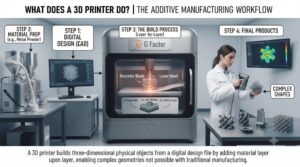
How Industrial 3D Printing Works (Step-by-Step)
Understanding the workflow helps explain why this technology is so powerful.
1. 3D Design Creation
Engineers design parts using CAD software such as:
- SolidWorks
- Fusion 360
- Rhino
- AutoCAD
The model defines geometry, strength requirements, and functional design.
2. File Conversion & Slicing
The CAD file is converted into formats like STL or OBJ.
Then slicing software breaks it into thin layers and generates machine instructions (G-code).
3. Machine Preparation
Industrial printers are prepared by:
- Loading material (filament or pellets)
- Heating extrusion systems
- Calibrating build plates
- Setting temperature zones
At GFac FFF Systems, machines include servo motors, auto-leveling systems, and high-temperature nozzles for stable production.
4. Layer-by-Layer Printing
The printer deposits material layer by layer.
Each layer fuses with the previous one until the object is complete.
5. Cooling & Post-Processing
After printing:
- Parts are cooled
- Supports are removed
- Surface finishing may be applied
Industrial 3D Printing Technologies
There are several technologies, but two dominate industrial production at scale.
FFF (Fused Filament Fabrication)
FFF uses thermoplastic filament as raw material.
It is widely used for:
- Prototypes
- Functional parts
- Engineering models
At FFF Industrial Printing Systems, machines support precision printing with materials like PLA, ABS, PETG, and carbon-fiber composites.
Advantages:
- High precision
- Lower entry cost
- Easy material handling
- Suitable for engineering parts
Learn more materials here:
FFF Filament Materials
FGF (Fused Granular Fabrication)
FGF uses plastic pellets instead of filament.
This is ideal for large-scale manufacturing.
At GFac FGF Systems, proprietary screw extrusion technology enables high-speed industrial production.
Advantages:
- Lower material cost
- Faster extrusion rate
- Large build volumes
- Ideal for industrial parts and molds
Explore materials:
FGF Pellet Materials
FFF vs FGF Comparison
| Feature | FFF | FGF |
|---|---|---|
| Material | Filament | Pellets |
| Cost | Higher | Lower |
| Speed | Medium | High |
| Scale | Small–Medium | Large |
| Use Case | Precision parts | Industrial production |
Industrial Materials Used in 3D Printing
Material choice directly affects performance.
Common FFF Materials:
- PLA (biodegradable, easy printing)
- ABS (strong and heat-resistant)
- PETG (chemical resistant)
- PLA-CF (carbon fiber reinforced)
Common FGF Materials:
- ABS Pellets
- TPU (flexible elastomer)
- PC+CF (high strength composite)
- PA+GF (glass fiber nylon)
- PPS+CF (high-performance engineering polymer)
View full material range:
Materials Overview
Real-World Industrial Applications
Industrial 3D printing is used across multiple sectors.
Automotive Industry
Used for:
- Prototypes
- Custom parts
- Jigs and fixtures
- Interior components
Benefits:
- Faster development cycles
- Lower tooling costs
Aerospace Industry
Used for:
- Lightweight components
- Functional prototypes
- Tooling and molds
Benefits:
- Weight reduction
- High precision engineering
Architecture & Construction
Used for:
- Building models
- Facade components
- Interior design structures
Benefits:
- Complex geometry production
- Faster design iteration
Marine & Shipbuilding
Used for:
- Hull models
- Large structural parts
- Prototyping marine components
Benefits:
- Reduced production time
- Large-scale capability
Medical Applications
Used for:
- Surgical models
- Prosthetics
- Anatomical replicas
Benefits:
- Custom patient-specific solutions
Case Insight (Industrial Application Example)
A large-format FGF system can produce a full-scale automotive bumper prototype in a single print run instead of assembling multiple molded parts.
This reduces:
- Assembly time
- Material waste
- Tooling dependency
This is exactly the type of production efficiency modern manufacturers are adopting globally.
Benefits of Industrial 3D Printing
1. Faster Production
Digital design to physical product in hours or days.
2. Lower Cost
Reduces tooling and waste material.
3. Design Freedom
Complex geometries without manufacturing limits.
4. Scalable Manufacturing
From prototypes to full production runs.
5. Customization
Ideal for tailored industrial components.
Challenges in Industrial 3D Printing
Despite advantages, some limitations exist:
- Surface finishing requirements
- Initial machine investment
- Material limitations for extreme environments
- Production speed for mass manufacturing
However, hybrid systems and advanced materials are rapidly solving these challenges.
Future of Industrial Additive Manufacturing
The future is moving toward:
- AI-driven printing systems
- Hybrid additive + subtractive machines
- Smart factories (Industry 4.0)
- Sustainable materials
- Fully automated production lines
Large-format systems will play a major role in replacing traditional manufacturing workflows.
Frequently Asked Questions (FAQ)
What is industrial 3D printing?
It is a manufacturing process that builds parts layer by layer using digital designs and industrial-grade materials.
How does industrial 3D printing work?
It works by converting a CAD file into layers, which are then printed using FFF or FGF systems.
What industries use industrial 3D printing?
Automotive, aerospace, architecture, marine, medical, and manufacturing industries.
What is the difference between FFF and FGF?
FFF uses filament, while FGF uses pellets for faster and cheaper large-scale production.
Is industrial 3D printing expensive?
Machines can be expensive, but long-term savings in tooling and material waste make it cost-efficient.
Summary
Industrial 3D printing is transforming global manufacturing by replacing traditional production methods with fast, flexible, and cost-efficient additive systems.
With technologies like FFF and FGF, companies can produce everything from small prototypes to massive industrial components.
At GFac Singapore, advanced large-format systems are helping industries scale production, reduce costs, and innovate faster than ever before.