
Robotic Arm 3D Printer and Pellet 3D Printing Solutions
Home – Robotic Arm 3D Printer
Industrial-Grade Large Format 3D Printing System
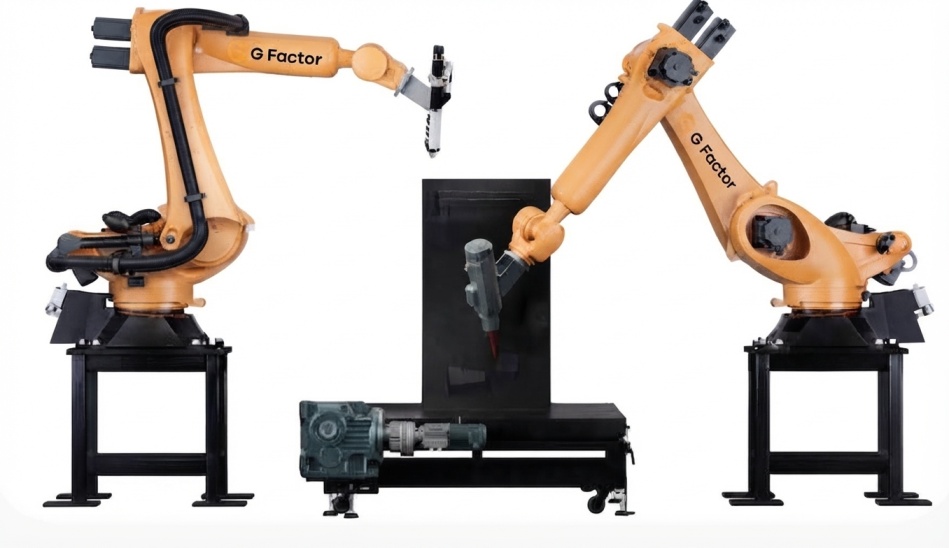
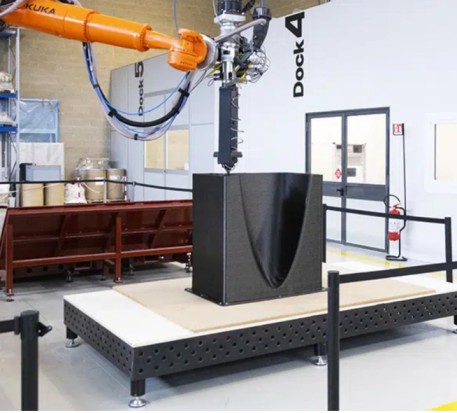
G Factor’s Robotic Arm 3D Printer and Pellet 3D Printing Solution combines a KUKA 210 2700 robotic arm with a pellet extrusion system to provide flexible, large-format additive manufacturing solutions for industrial applications
1. KUKA 210 2700 & Pellet Ext P10 Specifications
Basic Configuration for Robotic 3D Printing
The KUKA 210 2700 robotic arm and Pellet Ext P10 are the basic-level models of G Factor’s robotic 3D printing solution.
The KUKA 210 2700 provides a 270 cm reach, 210 kg payload capacity, and 0.05 mm repeatability, while the Pellet Ext P10 provides pellet-based extrusion with a throughput of up to 10 kg/h.
These models provide a reliable starting configuration for large-format robotic additive manufacturing, while the overall system can be customized according to specific requirements.
2. Customizable Configuration with No Fixed Size Limitation
Customized to Your Requirements
The key advantage of G Factor’s robotic 3D printing system is its high level of customization.
The KUKA 210 2700 and Pellet Ext P10 represent the basic-level configuration, not a fixed limitation of the overall system.
The robotic 3D printing solution can be customized according to the required size, specifications, working area, robotic configuration, extrusion system, materials, and production requirements.
Unlike conventional 3D printers with a fixed build chamber and standard build volume, the robotic system can be configured for different part sizes, working areas, applications, and manufacturing requirements.
There is no fixed standard printer size restricting the system configuration. G Factor can customize the system based on the customer’s specific application and production needs.
3. Auxiliary Equipment & Hybrid Workflow
Integrated Additive and Subtractive Manufacturing
The system can be equipped with auxiliary equipment and additional robotic systems to support an integrated hybrid manufacturing workflow.
The hybrid configuration allows two robotic systems to work together in one operation:
- Robot 1 – Additive Manufacturing: Large-format 3D printing
- Robot 2 – Subtractive Manufacturing: CNC machining
This enables additive manufacturing and subtractive manufacturing (CNC) to be combined within one coordinated operation, creating a more integrated robotic manufacturing workflow.
Additive Manufacturing + CNC Machining → Finished Component
This is better than writing “unlimited printing size”, because it communicates the client’s meaning while avoiding an overly absolute technical claim.
What We Offer
Robotic 3D Printing Solutions for Large-Scale Manufacturing
From large prototypes and composite molds to industrial tooling and production components, G Factor provides flexible robotic 3D printing solutions designed for different manufacturing requirements.
Large-Format Robotic 3D Printing
Large-scale pellet 3D printing using a multi-axis robotic arm for complex parts, molds, tooling, structures, and prototypes.
High-Throughput Pellet Extrusion
Industrial pellet extrusion technology designed for high material deposition rates, with flexible nozzle and material feeding configurations.
Hybrid Additive Manufacturing
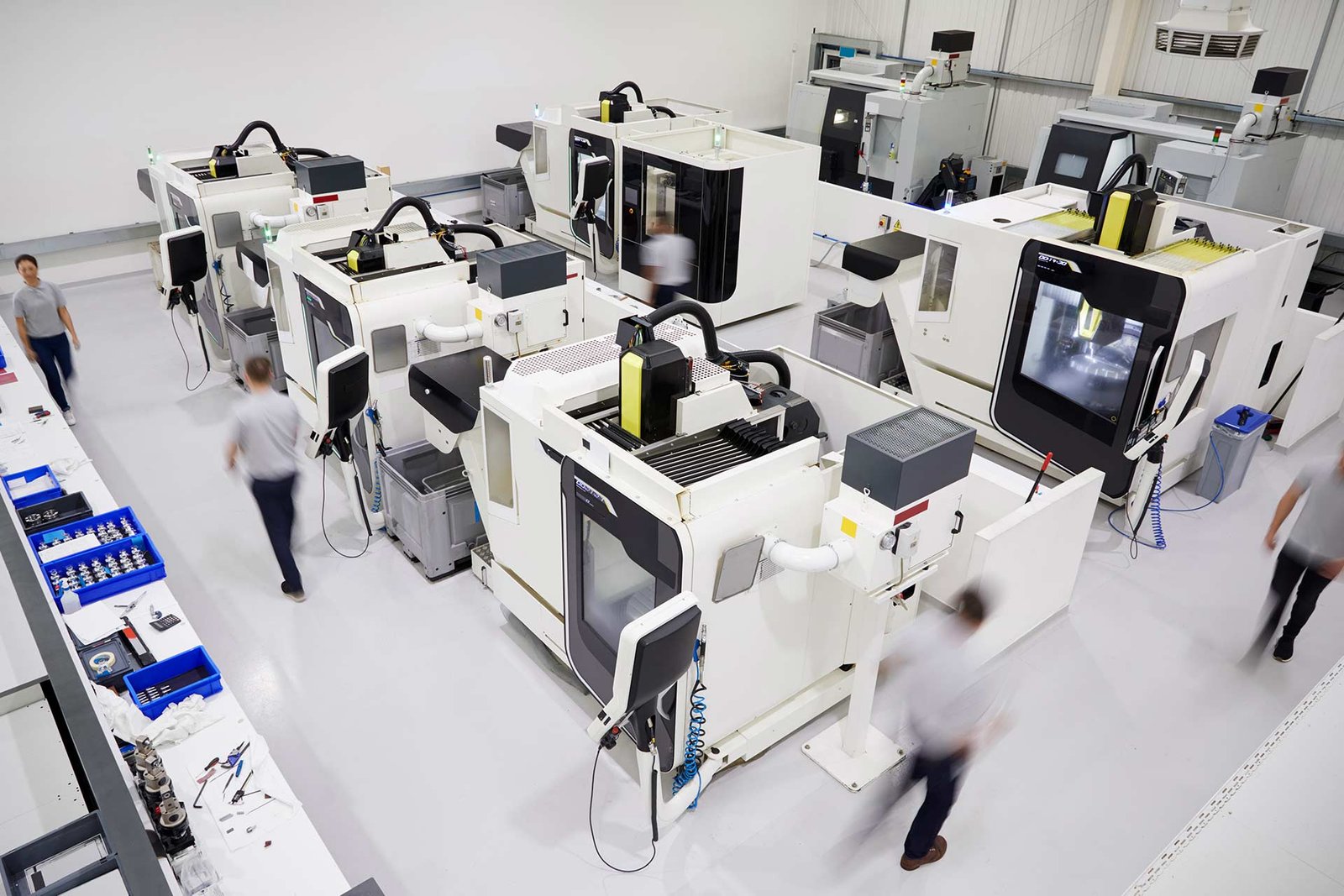
Combine robotic 3D printing with CNC machining to produce large near-net-shape parts and achieve the required dimensions and surface finish.
Industrial Applications
Robotic 3D printing for automotive, marine, aerospace, architecture, furniture, composite manufacturing, tooling, and large-scale prototyping.
Explore Smarter Solutions That Drive Results
Our Products
GFac 3D Printing Solutions | FFF, FGF & Materials
GFac offers industrial 3D printing solutions including FFF printers, FGF large-format systems, and advanced materials
Explore GFac 3D Printing Solutions

Testimonials
Proven Results Backed by Real Feedback
0
8,993 Reviews
We take pride in consistently exceeding expectations with expert support reliable service and high performance 3D solutions every time.
Your 3D prints exceeded expectations with incredible detail and durability. Fast delivery and professional support made the process seamless.

James Ellison
Product Designer
Exceptional accuracy on complex models. Your expertise helped accelerate our prototyping phase without compromising quality.

Dr. Lisa Clara Mendez
Biomedical Engineer
We rely on your precision printing for turbine prototypes. The parts are consistently flawless and delivered within our tight deadlines.

Marcus Tran
Lead Mechanical Engineer
FAQ
Advanced Additive Manufacturing by G Factor
A Robotic Arm 3D Printer uses an industrial robotic arm to move a 3D printing extrusion system along programmed paths. This provides greater movement flexibility than a conventional fixed-bed 3D printer.
The system is designed for pellet-based thermoplastic materials. Material selection depends on the extrusion configuration, temperature requirements, application, and required mechanical or thermal properties.
The robotic configuration provides a 270 cm arm reach and up to 300 cm vertical height difference. The practical printing envelope depends on the complete system configuration, workpiece geometry, robot positioning, and application requirements.
The overall system specification supports extrusion throughput of up to 20 kg/h. The Pellet Ext P10 configuration provides up to 10 kg/h throughput.
The overall system supports nozzle options from 1 mm to 20 mm. The P10 configuration supports 1, 2, 4, 6, 8, and 10 mm nozzles.
Pellet extrusion is suitable for high-throughput large-format applications because thermoplastic pellets can be processed directly through the extrusion system. It is particularly useful when large amounts of material need to be deposited efficiently.
Yes. The system can be used for applications such as automotive, marine, and aerospace composite molds, as well as industrial tooling and large prototypes.
Yes. G Factor’s robotic printing solution can be integrated into a hybrid additive-subtractive workflow, where a large part is 3D printed and subsequently CNC machined for improved dimensional accuracy and surface finish.
Robotic offline programming is used to prepare and manage printing paths. The available software options can support path planning and preparation for complex robotic printing applications.
Why choose G Factor?
We are committed to pushing the boundaries of additive manufacturing through continuous innovation, advanced engineering systems, and real-world industrial implementation.

We Turning imagination into reality through precision and innovation.